Hybrid Absorber Solutions: Ferrite \+ Foam for Full Coverage

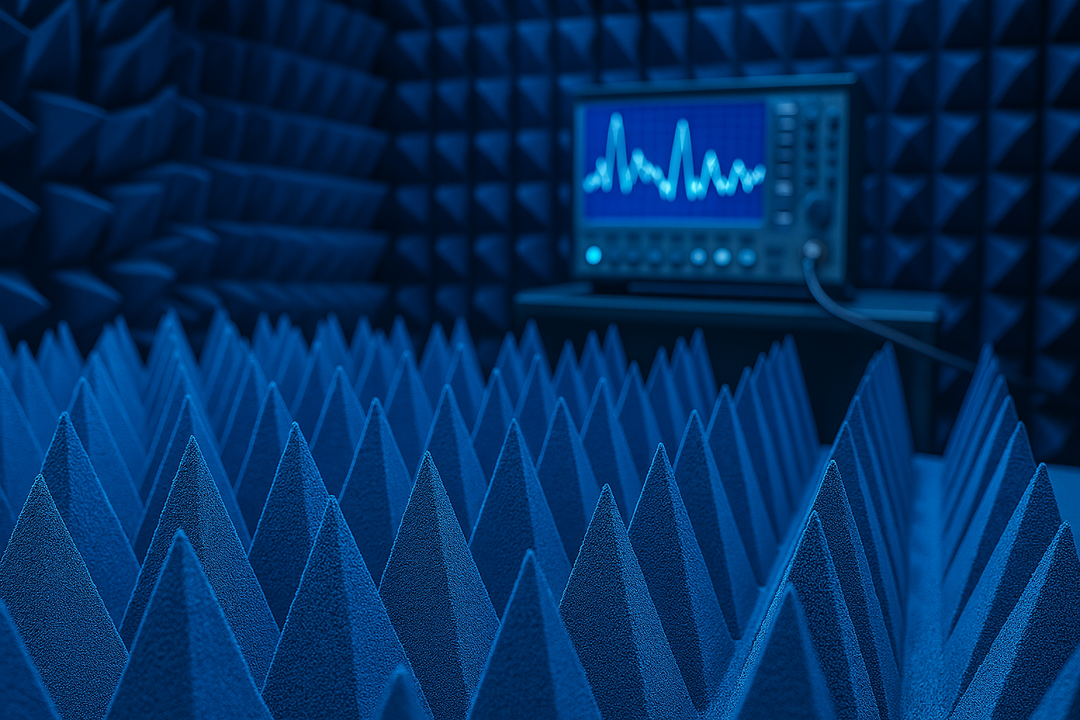
When engineers design an anechoic chamber, one of the first questions that comes up is frequency coverage. Foam works well at high frequencies. Ferrite handles the low end. But what happens when a facility needs both – without the footprint of a massive foam installation?
That's where a hybrid absorber earns its place. Understanding how microwave absorbers work is the first step in seeing why combining materials is so effective.
What Is a Hybrid Absorber and How Does It Work?
A hybrid absorber combines a sintered ferrite tile base with a carbon-loaded pyramidal foam layer mounted on top. The two materials work in tandem: ferrite covers the 30 MHz–1 GHz range through magnetic loss, while the foam handles 1 GHz–40 GHz through ohmic loss as energy travels down the pyramid taper.
The critical engineering challenge sits at the interface between the two layers. The foam must allow low-frequency waves to pass through to the ferrite below, while still absorbing high-frequency energy before it gets there. That balance – called impedance matching – is what separates a well-engineered hybrid absorber from a generic stacked solution.
Key principle: When foam impedance is correctly matched to the ferrite substrate, the system delivers broadband attenuation of -15 dB or better from 30 MHz to 18 GHz, with performance extending past 40 GHz in optimized configurations.
Why Each Material Falls Short on Its Own
Understanding why hybrid absorbers matter starts with knowing what single-material solutions can't do.

The Foam-Only Problem
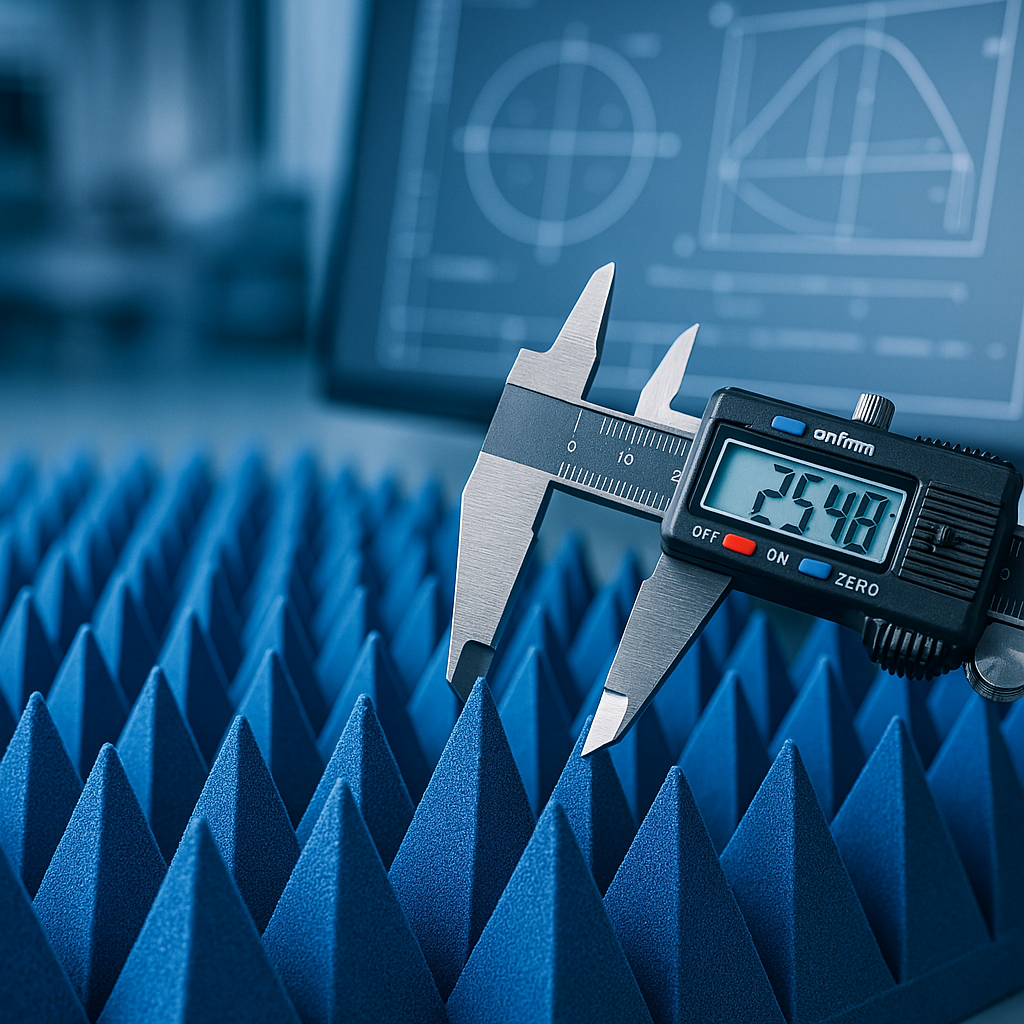
Pyramidal foam absorbers rely on tapered geometry to gradually transition impedance from free space to a lossy backing material. That taper is effective – but its low-frequency performance is entirely dependent on physical size.
Consider the numbers:
- A 96-inch pyramidal absorber delivers \~35 dB at 125 MHz and \~50 dB at 13 GHz
- A 4-inch pyramidal absorber offers almost no useful absorption below 1 GHz, but still reaches \~50 dB at 13 GHz
For a compact chamber that needs to start testing at 30 MHz, foam-only designs would require pyramids two to three meters tall. That's rarely feasible.
The Ferrite-Only Ceiling
Ferrite tiles solve the low-frequency problem elegantly. Their complex magnetic permeability closely matches their dielectric constant, creating near-free-space impedance at the surface and strong absorption – typically 10 dB to 25 dB across 30 MHz to 1 GHz.
But ferrite can't extend meaningfully into microwave frequencies. Past 1 GHz, performance drops off, and a ferrite-only chamber simply won't meet modern broadband testing requirements.
How the Layered Structure Solves Both Problems
The hybrid absorber design stacks these two materials in a specific way that makes the shortcomings of each irrelevant.
The ferrite tile mounts directly to the shielded wall. The wall backing reinforces low-frequency absorption – exactly where ferrite performs best. Above the tile, the pyramidal foam layer takes over, using the same tapered ohmic loss mechanism as standalone foam, but now operating from a matched base rather than an arbitrary substrate.
Because the ferrite handles the low end, the foam pyramids can be significantly shorter than a foam-only installation would require. That single fact changes the economics and spatial requirements of compact chamber design entirely.
The foam itself can be manufactured from either:
- Open-cell polyurethane – more common, good acoustic absorption alongside RF performance
- Closed-cell materials (polystyrene, polyethylene) – better moisture resistance, suited to controlled environments
Each has different long-term stability characteristics, and the right choice depends on the chamber environment and test frequency targets.
Performance Benchmarks Worth Knowing
Hybrid absorbers provide measurable, documented performance that stands up to third-party verification.
| Frequency Range | Primary Absorber | Typical Attenuation |
|---|---|---|
| 30 MHz – 1 GHz | Ferrite tile | 10–25 dB |
| 1 GHz – 18 GHz | Pyramidal foam | 15–50+ dB |
| 18 GHz – 40 GHz | Pyramidal foam | 50+ dB |
Note: Flat foam absorbers – which use stacked homogeneous layers instead of tapered pyramids – are capped at roughly 20 dB across their design range due to higher front-face reflections. Hybrid designs exceed this across the full broadband spectrum.
What Testing Standards Require This Level of Coverage?
Several widely adopted standards specify testing requirements that start below 1 GHz—right where foam-only chambers struggle most.
The key ones include:
- CISPR 16-1-4 – governs EMC testing site validation for radiated emission measurements, with requirements starting at 30 MHz
- MIL-STD-461 – U.S. military EMI/EMS standard covering radiated emissions and susceptibility from 30 Hz to 40 GHz
- ANSI C63.4 – commercial radiated emissions testing, 30 MHz and above
For any facility operating under these standards, a hybrid absorber isn't an upgrade – it's often the only viable solution that fits within normal chamber dimensions.
Who Uses Hybrid Absorbers?

Testing Facilities and EMC Labs
Independent EMC test labs certifying products for both commercial and military markets need consistent broadband performance across a wide client base. A chamber lined with hybrid absorbers handles radiated emission (RE) and radiated immunity (RI) testing without needing separate configurations for different frequency zones.
Automotive and Defense Applications
Automotive OEMs and Tier 1 suppliers testing vehicle electronics deal with complex, multi-frequency electromagnetic environments. Defense contractors operating under MIL-STD requirements face equally demanding broadband specifications. In both cases, hybrid absorbers deliver the coverage that compliance demands – without requiring facilities to be rebuilt around oversized foam installations.
Antenna Measurement Sites
Antenna test ranges need predictable, stable absorber performance across every operating frequency of interest. A hybrid absorber ensures that chamber behavior doesn't change character depending on whether a low-frequency or high-frequency antenna is under test.
The Real-World Advantages of Going Hybrid
Beyond raw attenuation numbers, hybrid absorbers offer several practical benefits that affect installation planning, safety compliance, and long-term facility management.
Space efficiency. Shorter foam pyramids mean more usable chamber volume. For a 3-meter or 5-meter chamber, that's a measurable difference in test geometry.
Reduced fire load. Less total foam volume across the chamber means a lower fire load – a genuine safety and insurance advantage in facilities where fire code compliance is closely monitored.
Versatility across test types. The same chamber configuration handles emissions and immunity testing, commercial and military standards, and a wide span of product categories without modification.
Pro Tip: When specifying a hybrid absorber system, request third-party attenuation data across the full frequency range – not just the high-frequency performance. The low-frequency curve is where the real differentiation between manufacturers shows up.
Limitations to Plan Around
Hybrid absorbers aren't the right fit for every situation, and there are two constraints worth planning around, honestly.
Weight. Ferrite tiles weigh approximately 10 lbs per square foot. Across a full chamber installation, that adds up fast. Structural wall reinforcement, mounting hardware, and installation logistics all require more planning than a foam-only project.
Cost. Hybrid absorbers cost more per panel than pyramidal foam alone. The ferrite tile base, precision foam formulation, and quality-controlled impedance matching all contribute to a higher unit price. For large chambers where the cost per square meter adds up, that difference is worth quantifying early in the project.
Spec the Right Absorber for Your Chamber
DB Absorber supplies pyramidal anechoic absorbers for EMC testing, antenna measurement, and military compliance environments. Whether the project calls for a compact 3-meter chamber or a full-scale test facility, the absorber specification determines whether the finished chamber meets its performance targets – or falls short at the edges of its frequency range.
Browse DB Absorber's full range of pyramidal and hybrid absorber solutions, and get the technical support to match the right product to your chamber requirements.
Frequently Asked Questions
What frequency range does a hybrid absorber cover?
A well-engineered hybrid absorber covers 30 MHz to 40 GHz in a single installation. Some configurations extend performance to 20 MHz at the low end.
Can hybrid absorbers be used for both emission and immunity testing?
Yes. The broadband coverage and consistent attenuation make them suitable for radiated emission (RE) and radiated immunity (RI) testing without chamber reconfiguration.
How does a hybrid absorber differ from a flat foam absorber?
Flat foam absorbers use stacked homogenous layers and are limited to around 20 dB of attenuation. A hybrid absorber exceeds that ceiling across the full frequency range by combining ferrite magnetic loss with pyramidal foam ohmic loss.
Does the foam formulation affect performance?
Significantly. The carbon loading in the foam must be specifically matched to the ferrite tile base. Off-the-shelf foam placed on a ferrite tile will not deliver the same results as an engineered hybrid system.
Which manufacturers produce hybrid absorbers?
Established suppliers in this space include SIEPEL, DMAS, DJM Electronics, and Holland Shielding. Each offers specific configurations tailored to different chamber sizes and testing standards.