Future-Proofing Commercial RF Chambers for the 2030s

Wireless testing budgets are climbing fast, and the numbers explain why. The global RF anechoic chamber market was valued at $1.2 billion in 2025 and is projected to reach $1.9 billion by 2034, growing at a CAGR of 6.8%, according to a 2026 industry report. That growth isn't abstract – it reflects a real shift happening inside test labs right now, where facilities built for 4G or early 5G are running into hard limits.
The pressure comes from several directions at once: higher frequencies, stricter shielding requirements, and devices that generate more heat than older test protocols ever accounted for. Labs that don't adjust risk producing unreliable compliance data, which is a costly problem to discover after a product has already shipped.
Why Older RF Chambers Are Struggling to Keep Up
Frequency expansion is the short answer. Full anechoic chambers (the segment covering far-field antenna measurement and precision RF characterization) – held 38.5% of market share in 2025, but demand is shifting toward chambers capable of handling millimeter-wave and sub-terahertz testing as 6G research accelerates. Automotive radar alone now regularly requires validated performance at 76–77 GHz, a range many older facilities were never designed to reach.
Regulatory pressure adds another layer. Standards such as IEC 61000, ANSI/IEEE 1528, and FCC Part 15 keep tightening, and non-compliance isn't a minor inconvenience – it can block market access entirely. A few figures put the scale of this shift into perspective:
- Automotive applications account for 31.5% of anechoic chamber demand, driven by EMC testing, radar validation, and V2X communication systems.
- Antenna measurement represents 36.5% of all testing categories performed inside these chambers.
- Global IoT connections are projected to grow from roughly 15 billion in 2025 to more than 25 billion by 2030, each device requiring some form of RF validation.
None of this means every facility needs a full rebuild. It does mean the components inside a chamber – particularly the material doing the actual absorbing – need to match the frequencies a lab is now expected to test.
What Future-Ready RF Chambers Actually Need
Retrofitting a chamber isn't about replacing everything at once. It's about identifying which parts of the system are creating measurement drift or leakage, then addressing those first. Absorber performance tends to be the most overlooked piece of that puzzle.
Absorber Quality Sits at the Center of Everything
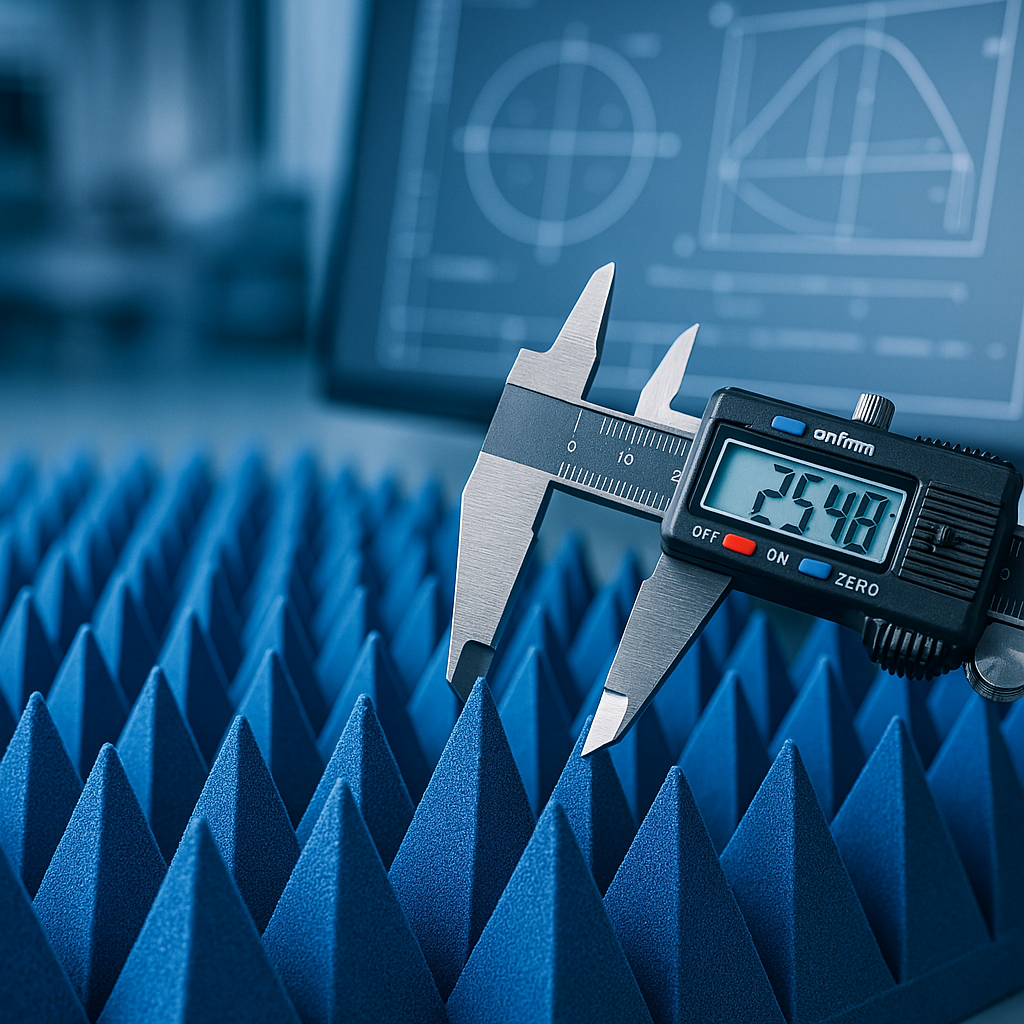
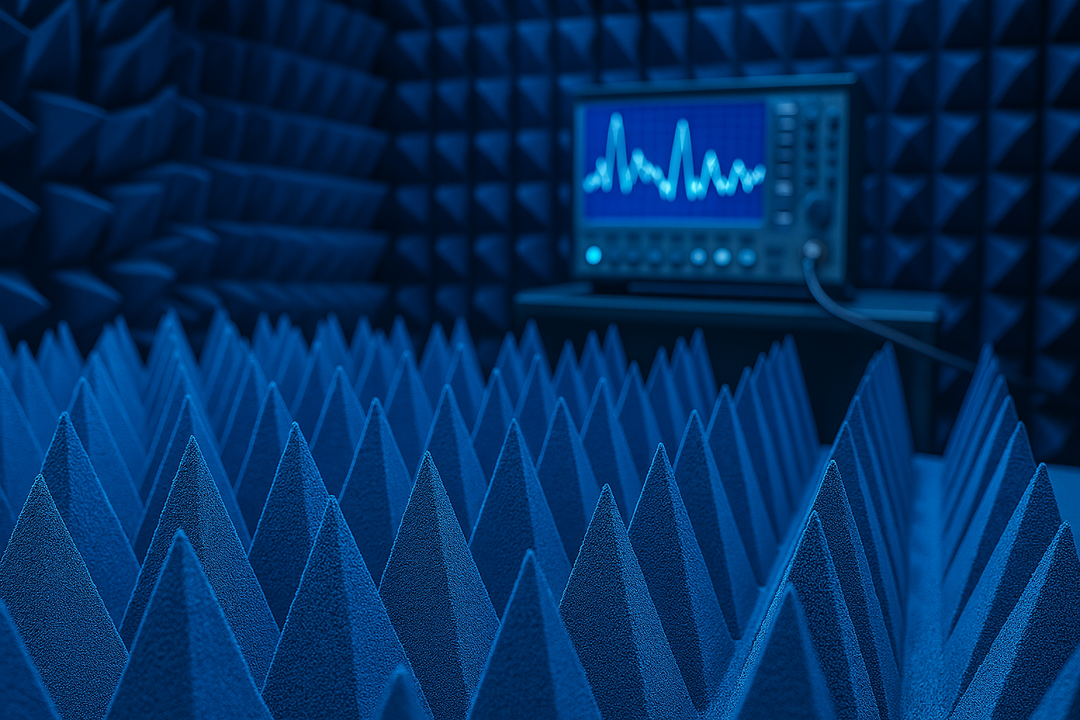
Pyramidal foam absorbers remain the industry standard for a reason. They deliver strong broadband attenuation from roughly 100 MHz up to 40 GHz, take up relatively little space, and cost far less than resistive or hybrid alternatives while still meeting most testing requirements. Pro tip: absorber cone geometry and foam density matter more than most spec sheets suggest – inconsistent manufacturing creates weak spots that show up as measurement noise long before anyone notices a visible defect.

Degraded absorbers don't fail all at once. They lose effectiveness gradually, and that gradual decline is often mistaken for equipment calibration drift rather than what it actually is – a material problem. Full absorber replacement is typically recommended every 10 to 15 years, though careless handling or improper cleaning can shorten that window considerably.
How does absorber choice affect measurement accuracy?
Reflection coefficients tell the story here. Chambers used for automotive radar testing at 77 GHz, for instance, are generally expected to maintain reflection coefficients below -30 dB. That level of performance depends almost entirely on absorber consistency across the full frequency range being tested, not just structural shielding around the room.
| Chamber Type | Market Share (2025) | Typical Cost Range | Best Suited For |
|---|---|---|---|
| Full Anechoic | 38.5% | $500K–$5M | Antenna pattern measurement, research |
| Semi-Anechoic | 32.0% | $300K–$900K | EMC compliance testing |
| Compact | 20.5% | $100K–$400K | Wireless module and IoT validation |
Facilities operating semi-anechoic or compact RF chambers don't need the same absorber investment as a full research-grade facility, but they still benefit from higher-quality pyramidal foam than budget alternatives typically provide. Cutting corners on absorber material to save money upfront tends to cost more later, once measurement uncertainty starts affecting certification outcomes.
Modular Panels and Structural Wear Points
Bolt-together shielding panels are becoming the preferred approach for labs that need flexibility without a full teardown. Interchangeable input/output bulkheads allow copper or coaxial connections to be swapped for fiber-optic feeds as testing needs evolve, extending a chamber's usable life by years.
Doors and access seals remain the single most common source of RF leakage in commercial chambers. Beryllium-copper finger stock and pneumatic seals reduce that risk considerably, but even the best door mechanism can't compensate for absorber material that's already degraded on the inside.
A Short List of What Tends to Fail First
Facility managers reviewing aging chambers usually find the same handful of issues repeating across sites:
- Compressed or cracked foam tips on pyramidal absorbers, which quietly reduce absorption efficiency.
- Worn door gaskets that leak signal at the seams rather than through the walls.
- HVAC vents without proper honeycomb shielding, acting as unintentional waveguides.
Addressing the first item on that list (absorber condition) usually delivers the fastest measurable improvement in test repeatability.
Planning Upgrades Without Overspending
Full facility replacement is rarely the right first move, and it's rarely necessary either. Compact chamber ROI research suggests payback periods of 12 to 36 months for manufacturers testing over 100 devices annually, largely because avoided contract testing costs and faster product cycles add up quickly.
What should a realistic upgrade sequence look like?
Start with the components creating the most measurement risk, not the ones that are easiest to replace. That usually means:
- Auditing current absorber condition against original specification sheets, checking for compression, discoloration, or brittleness.
- Verifying shielding effectiveness annually or semi-annually, ideally against IEC 61000-4-3 field uniformity requirements.
- Prioritizing absorber replacement in high-frequency zones before addressing lower-priority structural items.
This kind of staged approach lets a facility spread capital expenditure across a few budget cycles instead of absorbing one enormous cost all at once.
Where Absorber Sourcing Fits Into the Plan
Quality varies significantly across suppliers, even within the pyramidal foam category. Absorbers with consistent density, precise pyramid geometry, and documented attenuation performance across the intended frequency range hold up longer and produce more reliable results than commodity alternatives – a gap that becomes obvious the moment a chamber is pushed toward higher frequency testing.
For labs planning ahead of 6G-era requirements, sourcing decisions made now will determine how much rework is needed later. Absorber material purchased with headroom for higher frequency bands avoids a second, more expensive replacement cycle just a few years down the line.
Ready to Extend the Life of an Existing RF Chamber?
Facilities preparing for higher-frequency testing standards don't need to gamble on absorber quality. Precision-manufactured pyramidal foam absorbers, built for consistent attenuation across current and emerging frequency bands, offer a straightforward way to extend chamber performance without the cost of a full rebuild. Get in touch with dB Absorber team to discuss frequency requirements, chamber specifications, and replacement timelines, and receive a recommendation suited to the exact testing standards a facility needs to meet.
Frequently Asked Questions
How often should RF chamber absorbers be replaced?
Most manufacturers recommend full replacement every 10 to 15 years, though usage intensity and cleaning practices affect that timeline in either direction.
Can existing RF chambers be upgraded for higher frequency testing without a full rebuild?
In many cases, yes. Swapping absorber material, upgrading door seals, and adding shielded HVAC vents can extend a chamber's usable frequency range considerably without replacing the entire structure.
What's the difference between full and semi-anechoic chambers?
Full anechoic chambers absorb RF energy on all six interior surfaces, including the floor, making them suited for precise antenna pattern measurement. Semi-anechoic chambers keep a conductive ground plane floor, which works well for standard EMC compliance testing at a lower cost.
Why does absorber quality matter more as frequency increases?
Higher frequencies are less forgiving of inconsistent material density or imprecise pyramid geometry, so small manufacturing defects that go unnoticed at lower frequencies start showing up as measurable reflection and inaccurate readings.
Is it worth upgrading absorbers before other chamber components?
Generally, yes. Absorber performance has the most direct effect on measurement accuracy, and addressing it first often resolves issues that were previously misdiagnosed as equipment calibration problems.