RF Chamber Budget Breakdown for 2026: Full Cost Guide

The Ultimate RF Chamber Budget Breakdown for 2026
Budget planning for a new RF chamber is rarely clean. The gap between an early estimate and the final invoice can stretch into hundreds of thousands of dollars – because the real cost drivers hide in plain sight until the project is too far along to change course. Size, frequency targets, shielding class, and absorber quality all pull the number in different directions.
This breakdown covers what actually moves the price in 2026, where absorbers sit in that equation, and how simulation tools are changing what smart planning looks like before construction starts.
What Does an RF Chamber Cost in 2026?
Anywhere from a few thousand dollars to tens of millions – and that range reflects genuinely different facility types, not vague estimates.
Here's a realistic market overview for 2026:
| Chamber Type | Estimated Cost (USD) | Primary Cost Drivers |
|---|---|---|
| Desktop / Compact | $500 – $5,000 | Shielding box, basic foam absorbers |
| 3-Meter EMC | $100,000 – $300,000 | Ferrite tiles, hybrid absorbers, turntable |
| 10-Meter / Semi-Anechoic | $500,000M – $1M+ | Steel structure, HVAC, large absorber volume |
| Aerospace / Military | $1M+ | Custom footprint, high-frequency up to 110 GHz |
These approximate costs include complete-system figures – shielding structure, absorbers, RF doors, HVAC, and installation combined. The anechoic chamber price for a mid-range 3-meter EMC facility alone surprises first-time buyers who assumed the steel accounts for most of the spend.
Hidden Line Items That Inflate the Final Bill
Absorbers typically account for 30–40% of total project cost in a full-sized chamber. On a $500,000 build, that's $150,000–$200,000 for RF-absorbing materials alone.
Several other categories consistently get underestimated:
- HVAC and power conditioning – Filtered, temperature-stable ventilation is required for measurement repeatability and adds substantially to the build.
- RF-rated doors – A commercial door rated at 60–100 dB attenuation is a critical investment. Check our RF shielded doors guide for more details.
- Calibration and validation – Accredited labs must document performance before the RF chamber is used for compliance testing. This adds both time and cost to commissioning.
- Site preparation – Insufficient ceiling height, inadequate floor load capacity, or a missing ground plane can each trigger expensive facility upgrades before the build even begins.
Pro tip: Budget for these items at the proposal stage, not after the shielding contract is signed. By then, room dimensions are fixed and options narrow fast.
How Absorber Selection Shapes the Budget
Absorber choice is one of the most consequential – and most frequently rushed – decisions in an RF chamber project. Get it wrong and the consequences show up in measurement uncertainty, failed product submissions, and repeat testing fees.

The two main material categories work differently and serve different frequency ranges.
Pyramidal Foam vs. Ferrite Tiles: What Does the Difference Actually Cost
Ferrite tiles cover 30 MHz to roughly 600 MHz. They're effective at low frequencies but heavy, brittle, and expensive per unit. Most full-compliance chambers require them on walls and ceilings for the lower frequency bands.
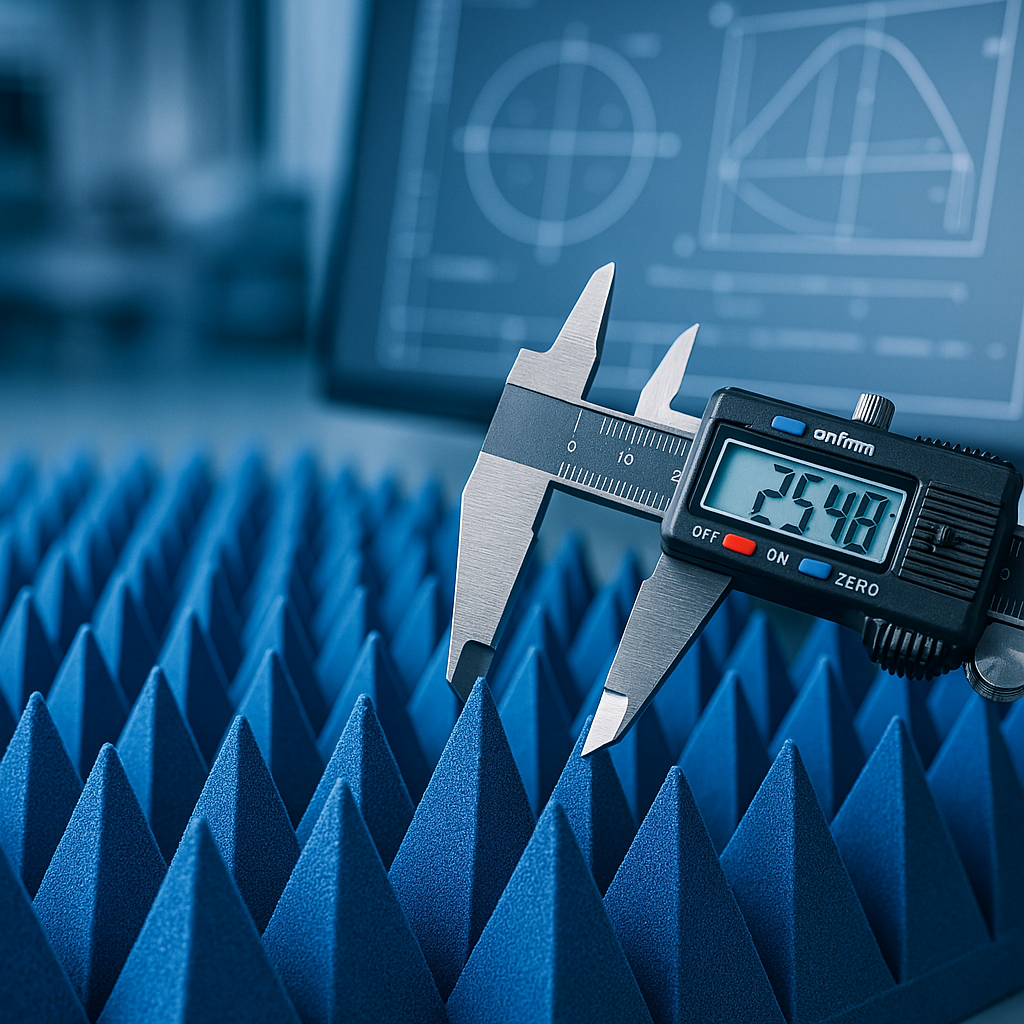
Pyramidal foam absorbers are carbon-loaded open-cell polyurethane, shaped so the gradual impedance transition from tip to base dissipates incoming RF energy across a broad frequency range – typically 200 MHz through 110 GHz depending on pyramid height and material density. For antenna measurement, OTA testing, and 5G millimeter-wave facilities, pyramidal absorbers are often the dominant lining material.
The pyramid height determines the lowest usable frequency. Taller absorbers reach further down the spectrum:
- 2-inch pyramidal – higher GHz range, compact installations ($500 / 10-count, dBAbsorber)
- 8-inch pyramidal – mid-range broadband coverage ($800 / 10-count, dBAbsorber)
- 18-inch pyramidal – extended lower-frequency reach ($1,850 / 10-count, dBAbsorber)
- 36-inch pyramidal – maximum broadband performance, large chambers ($3,850 / 10-count, dBAbsorber)
Hybrid configurations combining ferrite tiles at lower frequencies with pyramidal foam at higher frequencies are standard in 3-meter EMC and larger facilities. This is where the 30–40% absorber cost figure comes from in practice.
When Absorber Age Becomes a Budget Problem
Carbon-loaded foam degrades over time – UV exposure, moisture absorption, and physical compression all reduce effectiveness. Industry data recommends budgeting for partial or full absorber replacement when purchasing a used chamber with materials older than 10–12 years.
Partial replacement typically runs $11,000–$90,000+ depending on chamber size – an expense that rarely appears in the original purchase price. For new builds, absorbers tested to NRL 8000 standards provide documented broadband performance, which is required when certification agencies validate the facility.
Reverberation Rooms, Simulation, and Smarter Planning
Not all RF testing calls for an anechoic chamber. Understanding the alternatives – and the role simulation plays before construction – can significantly affect both technical outcomes and total spend.
A reverberation room is a highly reflective enclosure designed to produce a statistically uniform electromagnetic field. It's used for radiated immunity testing, OTA throughput measurements, and certain MIL-STD evaluations.
Anechoic Chamber vs. Reverberation Room: Which One Do You Actually Need?
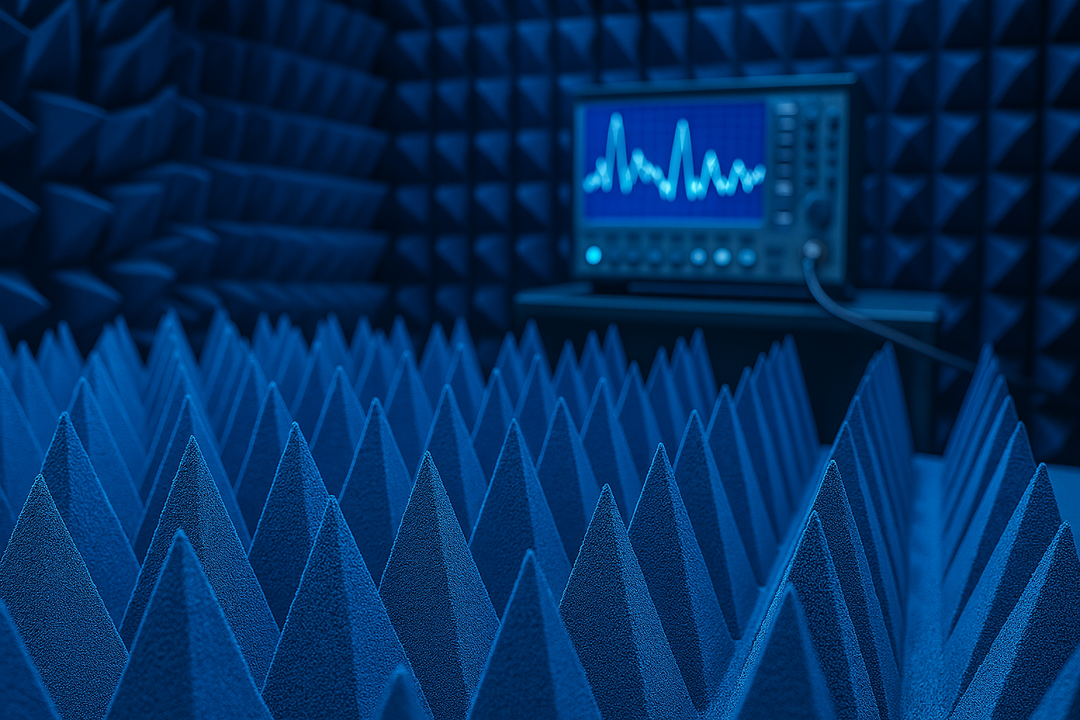
Anechoic chamber: walls, ceiling (and floor in fully anechoic configurations) are lined with RF-absorbing material. Used for antenna gain, radiated emissions, OTA sensitivity, and pre-compliance screening. Measurement results reflect free-space conditions.
Reverberation room: no absorber lining. The highly reflective interior creates statistical field uniformity. Lower construction cost, but limited to specific test applications – primarily immunity and throughput testing.
The choice depends entirely on which testing standards the lab must support. Organizations that need both often find the decision comes down to whether test volume justifies two separate facilities economically.

What Anechoic Chamber Simulation Actually Saves
Anechoic chamber simulation using computational electromagnetics tools like Ansys HFSS allows engineers to model the electromagnetic behavior of a proposed RF chamber design before a single panel is welded. Quiet zone uniformity, reflection hotspots, and absorber placement can all be validated virtually.
The financial impact is real. A design flaw caught in simulation costs a few hours. The same flaw found after installation means pulling absorbers, modifying structure, and rerunning validation tests. According to market analysis, simulation-led design can reduce pre-construction costs by up to 40% by removing expensive trial-and-error from the physical build.
For labs targeting specific frequency bands or non-standard chamber geometries, this step protects the rest of the budget.
How 5G and mmWave Requirements Are Raising Absorber Costs
Standard EMC testing at 1–3 GHz is well served by mid-tier pyramidal absorbers. But 5G NR, Wi-Fi 6E, automotive radar at 77 GHz, and satellite communications testing require finer pyramid geometry, tighter material tolerances, and verified high-frequency performance.
Facilities specified for testing up to 110 GHz – an increasingly common requirement in aerospace and defense – need absorbers with smaller pyramid tips and higher-density carbon loading. That premium compounds quickly when the surface area of a large chamber is factored in.
Why Absorber Quality Is a Quality System Decision
Treating absorbers as a commodity line item is a false economy. Every interior surface in an RF chamber contributes to overall measurement uncertainty. A chamber lined with underperforming absorbers might clear a basic normalized site attenuation check while still delivering inconsistent results at oblique angles or larger quiet zones.
Those inconsistencies surface as repeated test failures, rejected product submissions, and retesting fees – costs that are difficult to trace back to the absorber specification made at procurement. High-performance pyramidal absorbers with documented reflectivity across the full operating frequency range reduce that uncertainty from day one. For accredited labs, the absorber spec is part of the certification record.
Specify Absorbers Before the Shielding Contract Is Signed
The most common procurement mistake is treating absorber selection as a detail to finalize after the structure is designed. By that point, room dimensions are fixed, ceiling height is set, and the total surface area requiring coverage is locked in.
Specifying absorbers early – alongside the shielding design – preserves real flexibility: adjusting pyramid height for a target frequency, choosing full vs. semi-anechoic floor coverage, or phasing the installation to match available capital. Once steel is in the ground, those trade-offs are gone.
Planning a new RF chamber or upgrading an existing one? dBAbsorber's pyramidal absorbers ship from California within 1–2 business days, are tested to NRL 8000 standards, and cover 30 MHz to 110 GHz. Browse the full range or reach out directly to spec the right geometry for your facility's frequency range and quiet zone requirements.
FAQ: RF Chamber Budget Planning
How much of a chamber budget should go toward absorbers?
Typically, 30–40% of the total project cost. For a $300,000 facility, plan for $90,000–$120,000 in absorber spend before factoring in installation.
Can absorbers be replaced after a chamber is built?
Yes – partial replacement is common, especially in used chambers. Full replacement on a mid-sized facility runs $11,000–$90,000+ depending on absorber type and surface area.
What absorber height is right for a 5G test chamber?
Sub-6 GHz applications typically use 12- to 18-inch pyramidal absorbers. Millimeter-wave testing above 30 GHz may require shorter, denser profiles. Simulation should confirm placement before procurement.
What's the cost difference between anechoic and semi-anechoic?
Semi-anechoic chambers leave the floor reflective, which reduces absorber volume and total cost. Fully anechoic chambers cover the floor as well – adding absorber cost but enabling free-space measurement conditions required for certain antenna and OTA standards.
Does a reverberation room need pyramidal absorbers?
No. A reverberation room is designed to maximize reflections, not absorb them. Pyramidal absorbers are used in anechoic and semi-anechoic configurations only.