Anechoic Panels: Types, Performance & Selection Guide

Anechoic Panels: A Complete Guide to Types and Performance
RF engineers and EMC lab designers run into the same wall every time a new chamber project starts: pick the wrong panel thickness, and the consequences ripple outward – failed test results, blown budgets, missed delivery dates. Anechoic panels are not a commodity. The gap between a 2-inch absorber and a 36-inch one isn't cosmetic. It's rooted in physics, and getting it wrong costs real time and money.
This guide covers the main panel types, what certified performance data actually tells you, and how to select the right absorber for a specific frequency requirement.
What Anechoic Panels Are and How They Work
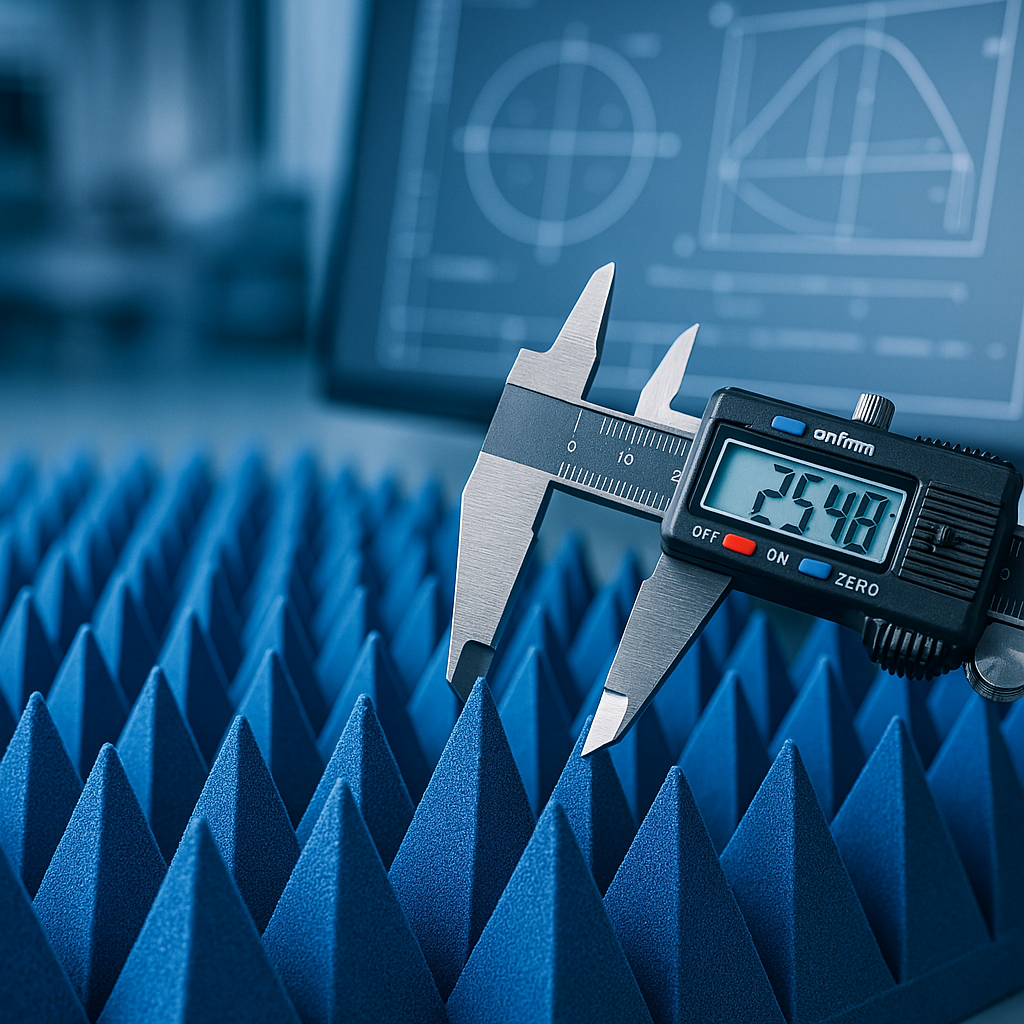
Anechoic panels absorb electromagnetic energy instead of bouncing it back into the test environment. The pyramidal shape isn't decorative – it creates a gradual impedance transition between free space and the absorber material, which progressively reduces reflections across a wide frequency band.
The base material is carbon-loaded polyurethane foam. Carbon loading is what gives the panels their electromagnetic absorption properties. A flat slab of the same foam would produce a hard surface reflection; the tapered pyramid geometry eliminates that by easing the transition for incident waves.

Why Reflectivity Numbers Tell the Real Story
Performance is measured in decibels of reflectivity – always a negative number, where lower values mean better absorption.
- -20 dB \= 1% of incident power reflected
- -40 dB \= 0.01% reflected
- -60 dB \= 0.0001% reflected
For EMC compliance testing, antenna pattern measurements, or radar cross-section work, the gap between those numbers translates directly into measurement accuracy. A chamber rated at -20 dB and one rated at -50 dB are not interchangeable for precision applications.
Pro tip: Any supplier worth considering should provide full measured reflectivity curves across the operating band – not just a cutoff frequency number. Panels certified to NRL 8000 standards have been independently validated, which separates professional-grade anechoic foam panels from acoustic products or generic foam that happens to look similar.
Pyramid Size vs. Frequency: What the Performance Data Shows
The relationship between pyramid height and low-frequency cutoff is the core selection variable. Larger pyramids absorb lower frequencies – and they also improve absorption depth at high frequencies, which surprises some engineers the first time they see the data side by side.
The table below uses measured reflectivity data for the four standard pyramidal sizes available from DB Absorber:
| Pyramid Height | Cutoff Frequency | Reflectivity Range | Best Application |
|---|---|---|---|
| 2 inch | 3 GHz | -20 dB @ 3 GHz → -45 dB @ 40 GHz | High-frequency microwave, 5G labs |
| 4 inch | 1 GHz | -20 dB @ 1 GHz → -50 dB @ 40 GHz | General-purpose EMC testing |
| 12 inch | 300 MHz | -20 dB @ 300 MHz → -60 dB @ 40 GHz | Aerospace & defense chambers |
| 36 inch | 30 MHz | Effective from 30 MHz through mm-wave | Full broadband anechoic chambers |
The 12-inch panel hitting -60 dB at 40 GHz – compared to -45 dB for the 2-inch at the same frequency – illustrates that larger panels don't just extend low-frequency range. They also deliver significantly deeper absorption across the entire band.
How to Match Panel Height to the Test Band
2-inch panels work well for applications operating entirely above 3 GHz: millimeter-wave component testing, 5G device characterization, high-frequency antenna measurement. Below 3 GHz, they don't absorb effectively, and reflectivity data from the chamber will show it.
4-inch panels cover 1 GHz to 40 GHz – the right fit for most commercial EMC labs running radiated emissions tests or antenna pattern work across standard wireless frequency bands.
12-inch and 36-inch panels are required when the test band dips below 1 GHz. The 12-inch handles 300 MHz to 40 GHz, covering most military and aerospace requirements. The 36-inch anechoic chamber panels extend coverage all the way to 30 MHz, which is necessary for VHF communications testing, L-band radar, and full broadband defense chamber builds.

Which Applications Require Which Panel Type
Different test environments place very different demands on anechoic foam panels. Matching the panel spec to the actual application – not just the nominal frequency range – is where most selection errors happen.
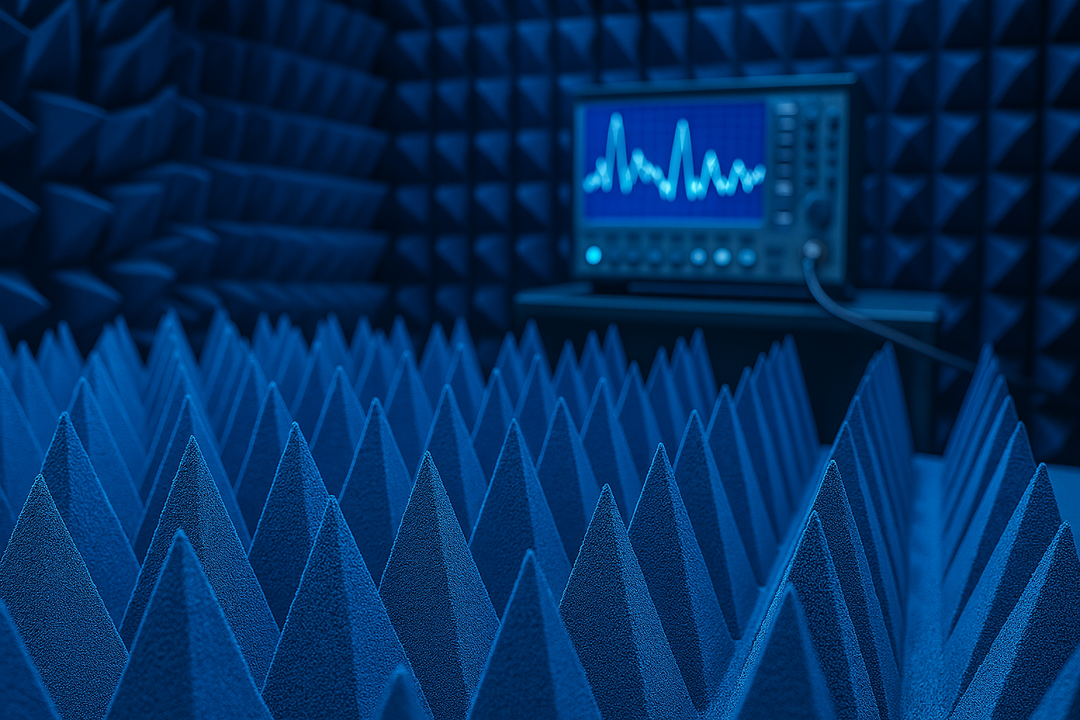
Commercial EMC labs running CISPR 16 or MIL-STD-461 testing typically need coverage from 30 MHz to 6 GHz. One common mistake: treating all chamber walls the same. Sidewalls near the antenna aperture interact with waves at oblique angles, which often demands a taller absorber than ceiling or floor panels require.
Antenna measurement and compact range facilities hold absorber performance to a stricter standard. A 1 dB reflectivity error in the chamber can translate to 0.5 dB or more of error in measured antenna gain – an error that compounds across an entire test campaign. For near-field systems and compact range setups, the 12-inch or 36-inch panels are typically the floor, not the premium option.
Radar cross-section (RCS) facilities require background levels in the -40 to -50 dB range as a baseline requirement. Same story for defense anechoic chambers used for ship radar testing, aircraft EW system validation, or satellite payload characterization – the 36-inch panel's 30 MHz starting point covers the full VHF-through-millimeter-wave range without requiring a hybrid wall treatment.
Why Availability Matters as Much as Specification
Custom-fabricated absorbers can carry lead times of six to eight weeks. For a project running against a hardware delivery milestone, that wait is a real scheduling problem – not a minor inconvenience.
DB Absorber stocks pyramidal anechoic panels at their California facility and ships within 1–2 business days. Fresh domestic inventory also reduces the risk of receiving foam that has degraded in long-term storage, which is a documented issue with some low-cost overseas suppliers.
When evaluating any panel source, these factors deserve the same attention as the technical specs:
- NRL 8000 certification or equivalent independent validation
- Full reflectivity curves across the operating band
- Confirmed material composition and density
- In-stock availability for the required pyramid height
- Domestic shipping timeline relative to project schedule
DB Absorber's NRL 8000-certified pyramidal anechoic panels ship from California stock in 1–2 business days, in sizes from 2-inch to 36-inch. Full reflectivity data is available for every panel height.
Frequently Asked Questions
What does cutoff frequency mean for pyramidal absorbers?
The cutoff frequency is the lowest frequency at which the panel achieves its rated minimum reflectivity (typically -20 dB). Below that point, absorption performance drops off sharply.
How do anechoic chamber panels affect measurement accuracy?
Every decibel of reflectivity in the chamber adds uncertainty to test data. For antenna gain measurements, a -20 dB chamber introduces significantly more error than a -40 dB chamber. Precision applications – RCS, near-field, compact range – require the lowest reflectivity panels available.
Can a single panel size cover an entire chamber's frequency range?
Often yes, depending on the band. A 12-inch panel covers 300 MHz to 40 GHz, which satisfies most defense and aerospace requirements without mixing panel heights. For commercial EMC labs operating down to 30 MHz, a 36-inch panel is necessary.
Why does pyramid height affect high-frequency performance, not just low-frequency?
Larger pyramids provide a longer electrical path through the absorbing material, which increases absorption depth across the entire band – not just at lower frequencies. The 12-inch panel's -60 dB at 40 GHz versus the 2-inch panel's -45 dB at the same frequency is a direct result of this.