RF Absorber Glossary
RF Absorber Glossary
Welcome to the dB Absorber technical glossary. These educational resources explain key concepts in RF and microwave absorber technology, anechoic chamber design, and electromagnetic compatibility testing.
Glossary Terms
What is Anechoic? · What is Volumetrically Loaded? · Pyramidal Absorber Configurations · NRL 8000 Requirements · What are EMC Measurements?
What is Anechoic?
Anechoic is a term that describes environments, materials, or chambers specifically designed to prevent or eliminate reflections of electromagnetic waves or sound waves. Anechoic technology is commonly used in RF/microwave engineering, telecommunications testing, and acoustic research to create reflection-free environments for accurate measurements and testing.
In simple terms, anechoic systems help engineers and researchers create controlled environments where electromagnetic or acoustic waves are absorbed rather than reflected. Unlike regular rooms or outdoor spaces where reflections can interfere with measurements, anechoic chambers provide a clean testing environment that simulates free-space conditions, allowing for precise characterization of antennas, radar systems, and electronic devices.
How Do Anechoic Chambers Work?
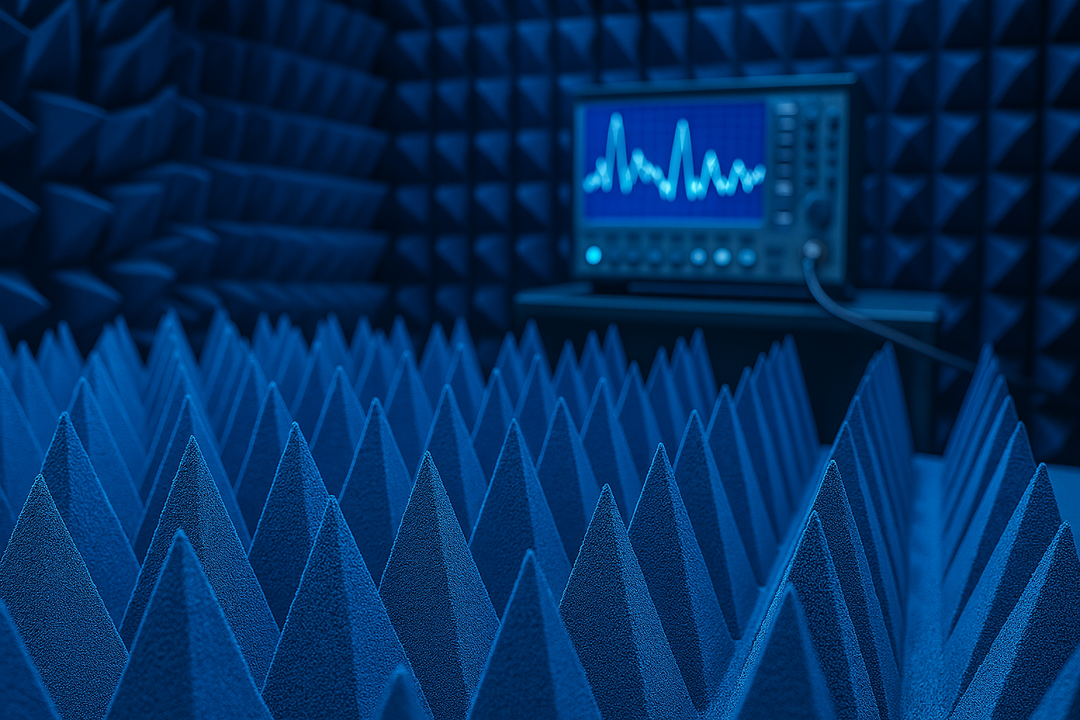
Anechoic chambers operate by absorbing electromagnetic or acoustic energy through specially designed materials and geometries. Once electromagnetic waves enter the chamber, they encounter absorbing materials that convert the wave energy into heat rather than reflecting it back. The chambers are constructed with walls, ceiling, and floor lined with absorbing materials that have specific dielectric properties optimized for the target frequency range.
For example, an RF anechoic chamber testing a cellular antenna will absorb the radiated electromagnetic energy using carbon-loaded foam pyramids, preventing reflections that could interfere with antenna pattern measurements. This enables engineers to accurately measure how the antenna radiates energy in different directions without contamination from environmental reflections.
Key Features of Anechoic Systems
Broadband Absorption: Anechoic chambers provide effective absorption across wide frequency ranges, with modern chambers covering from 30 MHz to 110 GHz for comprehensive testing capabilities.
Precise Quiet Zone: These chambers feature a central quiet zone where reflections are minimized to acceptable levels, ensuring accurate measurements within a defined testing volume.
Electromagnetic Shielding: Metal walls provide complete electromagnetic isolation, preventing external RF interference from contaminating sensitive measurements and maintaining controlled testing conditions.
Customizable Configurations: Anechoic chambers can be designed with various absorber types including pyramidal, wedge, and convoluted surface configurations to optimize performance for specific applications.
Compliance Standards: Professional anechoic chambers meet stringent requirements such as NRL 8000 specifications, ensuring fire safety and performance reliability in critical testing environments.
Applications of Anechoic Technology
Anechoic chambers are used for antenna pattern/gain/directivity testing, radar cross section and stealth technology development, EMC compliance testing, and wireless device certification (cellular, WiFi, IoT) across multiple frequency bands.
What is Volumetrically Loaded?
Volumetrically loaded refers to a specialized manufacturing process where conductive particles, typically carbon, are distributed uniformly throughout the entire volume of a base material rather than being applied only to the surface. This technique is commonly used in RF and microwave absorber manufacturing to create materials with consistent electromagnetic properties throughout their structure, ensuring optimal performance in anechoic chambers and electromagnetic shielding applications.
Unlike surface-coated materials where conductivity may vary or wear off over time, volumetrically loaded materials maintain consistent performance throughout their entire thickness and lifespan.
How Does Volumetric Loading Work?
Conductive particles are incorporated into the base material during manufacturing, typically while the material is in liquid or semi-liquid form, then thoroughly mixed throughout the entire volume before it cures or solidifies. For carbon-loaded RF absorber foam, carbon particles are mixed into liquid polyurethane before the foaming process begins; as the foam expands and cures, the carbon particles become permanently embedded throughout the structure, creating consistent dielectric properties from surface to core.
Key Features
Uniform Electrical Properties: Consistent conductivity and dielectric properties throughout the entire volume, ensuring predictable electromagnetic behavior across the material's thickness.
Enhanced Durability: Because particles are embedded throughout rather than coated on, these materials resist wear, scratching, and surface damage that could compromise electromagnetic performance.
Consistent Performance When Cut or Machined: Electromagnetic characteristics are maintained even when the material is cut, shaped, or machined, since loading extends through the entire volume.
Temperature Stability: Conductive particles are mechanically locked within the material structure, preventing migration or segregation that could occur with surface treatments.
Applications
Volumetrically loaded foams are used extensively in pyramidal and wedge absorbers for anechoic chambers, gaskets and shielding components, radar-absorbing composites for stealth applications, and electromagnetic shielding for sensitive electronic components.
NRL 8000 I, II and III Requirements
NRL 8000 I, II and III requirements are stringent fire safety and material standards established by the Naval Research Laboratory (NRL) for materials used in electromagnetic testing environments and anechoic chambers. These specifications define fire resistance, smoke generation, and toxicity standards required for use in military, aerospace, and high-security testing facilities.
How NRL 8000 Testing Works
Materials undergo a comprehensive testing protocol evaluating ignition resistance, flame spread rates, heat release characteristics, smoke production, and toxic gas emissions under standardized flame exposure. Only materials that pass all specified tests can be certified as meeting NRL 8000 standards.
Classification Levels
NRL 8000 I: The basic classification, establishing fundamental fire safety requirements for standard anechoic chamber applications where fire risk is moderate.
NRL 8000 II: An intermediate classification requiring improved flame resistance, reduced smoke generation, and lower toxic gas emissions — suitable for more critical environments or higher-occupancy facilities.
NRL 8000 III: The most stringent classification, requiring superior flame resistance, minimal smoke production, and extremely low toxic gas emissions, for the most critical military and aerospace testing facilities.
Applications
NRL 8000 compliance is required or preferred for military and aerospace testing facilities, high-security research facilities, and critical infrastructure testing environments where absorber materials must not contribute to fire risk in enclosed spaces.
All dB Absorber pyramidal foam products are manufactured to meet NRL 8000 fire safety standards.
What are EMC Measurements?
EMC (Electromagnetic Compatibility) measurements are systematic testing procedures used to evaluate how electronic devices and systems interact with electromagnetic environments — whether a device can operate without causing harmful interference to other equipment, and whether it can function correctly when subjected to electromagnetic disturbances from external sources.
How EMC Measurements Work
During emissions testing, equipment measures the electromagnetic energy radiated or conducted by the device under test against regulatory limits. During immunity testing, calibrated electromagnetic fields or conducted disturbances are applied to the device while operators monitor for malfunctions or performance degradation. For example, a laptop tested for EMC compliance is placed in an anechoic chamber where spectrum analyzers measure emissions across frequency bands while it's simultaneously subjected to controlled interference to verify continued normal operation.
Types of EMC Measurements
Radiated Emissions Testing: Measures electromagnetic energy radiated through space, typically conducted in anechoic chambers with calibrated antennas and spectrum analyzers.
Conducted Emissions Testing: Measures electromagnetic energy traveling through power lines, data cables, and other conductors using LISNs (Line Impedance Stabilization Networks).
Radiated Immunity Testing: Exposes devices to controlled electromagnetic fields to verify continued proper operation, simulating interference from radio transmitters, cell phones, and other radiating sources.
Conducted Immunity Testing: Injects electromagnetic disturbances directly into power and signal cables to test resilience against power line interference and switching transients.
ESD Testing: Simulates electrostatic discharge events to ensure devices can withstand and recover from static discharge without damage.
Applications
EMC measurements are mandatory for consumer electronics certification, automotive electronics, medical device compliance, industrial equipment certification, and military/aerospace systems — following standards such as CISPR, IEC, and FCC regulations across frequency ranges from 9 kHz to 40 GHz or higher.
Related Term: Pyramidal & Convoluted Absorber Configurations
Explore the geometric designs used in RF absorbers — pyramidal, wedge, and convoluted surfaces — and how they optimize electromagnetic wave absorption.
Why These Terms Matter
Understanding RF absorber technology helps engineers and procurement teams make informed decisions when specifying anechoic chamber materials. Our glossary covers the technical foundations that underpin our product line.
Our Products
All dB Absorber products are manufactured to meet NRL 8000 fire safety standards and provide broadband absorption from 30 MHz to 110 GHz. Browse our full selection of pyramidal absorbers, wedge absorbers, and specialty configurations.