Anechoic Chamber vs Reverberation Chamber: Comparison Guide

Anechoic vs. Reverberation Chambers: A Guide to Selecting Test Environments [2026]
An anechoic chamber absorbs reflections to create free-space conditions; a reverberation chamber does the opposite and multiplies them to build a stress-test field. That's the short answer. The longer answer determines whether a lab passes compliance testing on the first attempt or spends months chasing measurement errors that trace back to the wrong room.
Regulatory bodies are not loosening their grip on test-site accuracy either. FCC guidance for radiated emissions testing spells out that test facilities must meet applicable site validation requirements and document the measurement setup according to Section 2.948 before results count toward equipment authorization. A chamber that fails validation doesn't just produce bad numbers – it can invalidate an entire compliance filing, along with the schedule and budget built around it.
What Is an Anechoic Chamber?
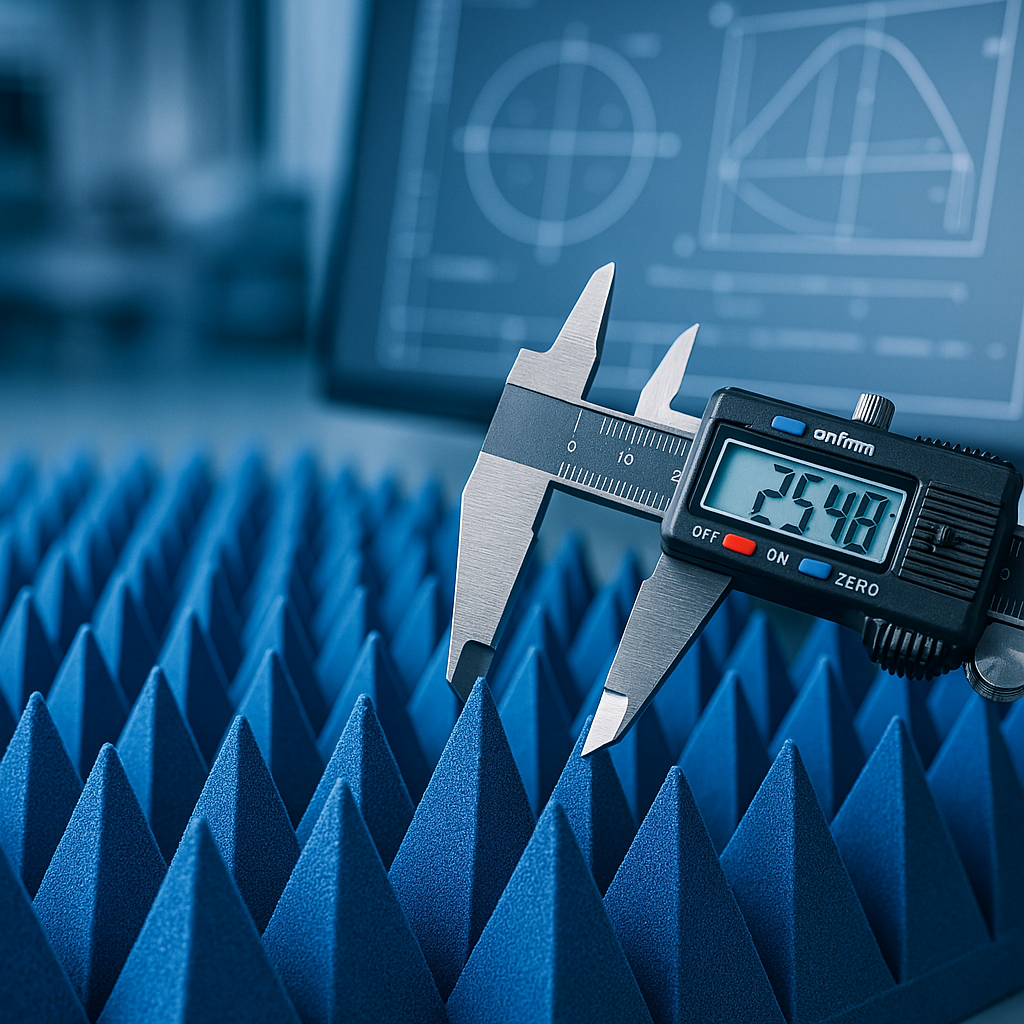
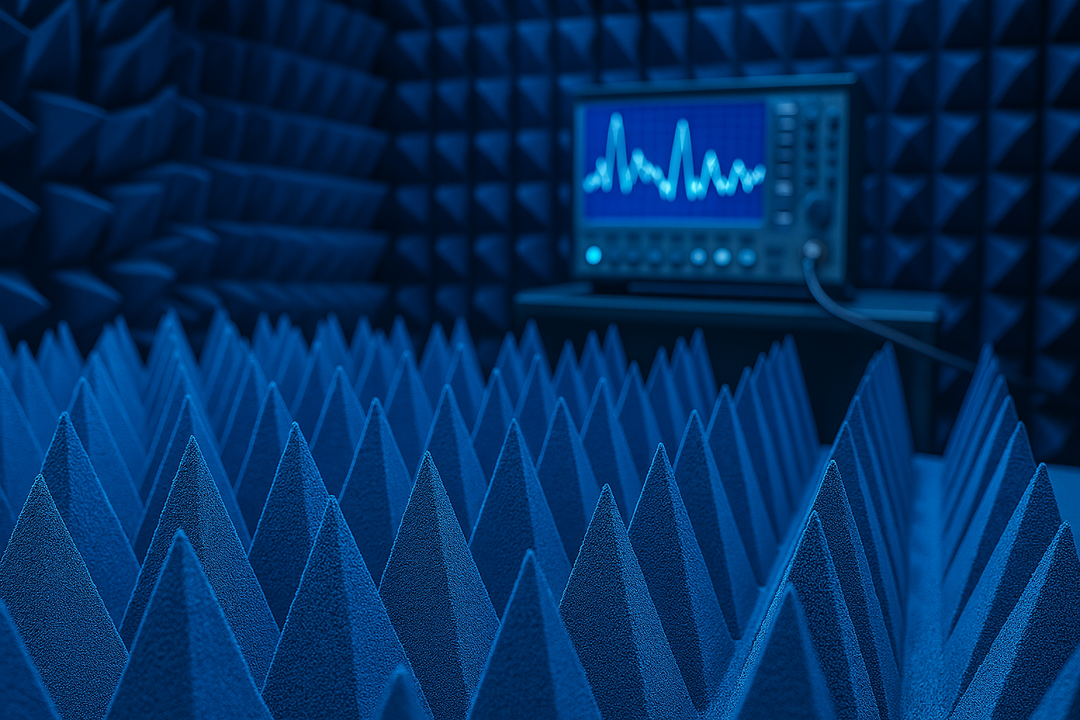
An anechoic chamber is a room engineered to eliminate reflections almost entirely. Pyramidal foam absorbers line the walls, ceiling, and sometimes the floor, converting incoming RF or acoustic energy into heat instead of bouncing it back into the test volume.
The result is an environment that behaves, electrically or acoustically, close to open space. That's the whole point: a device tested here shows its own true performance rather than a performance distorted by the room around it.

How the Pyramid Shape Works
The pyramid geometry isn't a design flourish. It creates a gradual impedance transition between open air and the lossy foam core, which is what makes the material effective at absorbing lower frequencies without needing an impractically thick slab.
Pro tip: absorber performance is frequency-dependent, not universal. A pyramid rated for strong absorption at 1 GHz will underperform at 200 MHz unless the pyramid height and density are specified for that lower band. Buying foam based on price alone, without checking its rated frequency curve, is one of the most common and most expensive mistakes labs make.
Where Anechoic Chambers Get Used
- Antenna pattern and gain measurement
- EMC radiated emissions and immunity testing
- Radar cross-section (RCS) evaluation
- Acoustic testing for speakers, microphones, and vehicle interiors
These use cases share a common thread: each one depends on isolating the device under test from the room itself, so any distortion in the data can be traced back to the hardware and not the environment.
What Is a Reverberation Chamber?
A reverberation chamber does the reverse job. Instead of absorbing energy, its bare metal walls reflect it repeatedly until the field inside becomes statistically uniform.
Rather than fighting reflections, the design leans into them. That approach turns out to be extremely useful for a different category of test question: not "how clean is this signal," but "how well does this device hold up when the signal environment is messy."

How Does a Reverberation Chamber Build a Uniform Field?
A mechanical stirrer (a large rotating paddle) shifts the standing wave pattern as it turns, which is what allows a reverberation chamber (sometimes called a reverberation room in acoustic contexts) to generate high field strength from comparatively low input power.
This setup mimics multipath conditions: signals scattering off walls, machinery, or terrain the way they would in a factory floor or a battlefield, rather than the clean, open-air conditions an anechoic chamber recreates. The statistical uniformity achieved through stirring is also what makes reverberation chambers repeatable enough for standardized immunity testing, despite the room being, by design, full of chaotic reflections.
Typical Reverberation Chamber Applications
- Electromagnetic immunity and susceptibility testing
- Radiated power measurement
- Aerospace and defense stress testing
- Sound power testing for industrial machinery and HVAC equipment
Anechoic Chamber vs Reverberation Chamber: Quick Comparison
| Factor | Anechoic Chamber | Reverberation Chamber |
|---|---|---|
| Wall treatment | Pyramidal foam absorbers | Bare, reflective metal |
| Field character | Quiet, free-space-like | Dense, multipath-rich |
| Best suited for | Precision antenna and acoustic measurement | Immunity and stress testing |
| Relative build cost | Higher (absorber material) | Lower (fewer absorbers needed) |
| Frequency accuracy above 18 GHz | Well-established methods | Still an open standards question |
That last row matters more than it looks. An IEEE technical workshop on chamber measurement noted that testing above 18 GHz has been conducted up to 231 GHz without a standardized validation method, since older assumptions about site accuracy below 18 GHz were never confirmed with real data at higher bands. Labs pushing into mmWave and beyond should treat both chamber types with extra scrutiny at those frequencies, rather than assuming a validation method that worked at 6 GHz still holds at 60 GHz.
Which Chamber Actually Fits the Test?
The decision usually comes down to what the data needs to prove.
- Precision antenna or acoustic data? An anechoic chamber removes the guesswork by isolating the device under test from every reflection in the room.
- Resilience under real-world interference? A reverberation chamber recreates that chaos far more cheaply than an anechoic chamber ever could.
- Tight budget, large test object? Reverberation chambers scale to bigger hardware – vehicles, aerospace assemblies – without the absorber costs climbing proportionally.
Some labs stop choosing altogether and run both, using the anechoic room for antenna and compliance work and the reverberation room for immunity testing. That's increasingly common in labs serving both commercial electronics clients and defense contractors, and it avoids outsourcing half the workload to a third-party facility every time a project needs the other type of test.
Why Absorber Quality Defines an Anechoic Chamber Quality
A chamber can be labeled "anechoic" and still fail validation if the absorber material isn't matched to the intended frequency range. Regulatory expectations have only gotten stricter on this front – NIST's National Voluntary Laboratory Accreditation Program updated its FCC equipment authorization checklist in 2024, tightening the technical requirements labs must meet to stay accredited for radiated testing.
Pyramidal RF absorber foam is where that accuracy either gets built in or lost. Getting the pyramid height, density, and fire rating specified for the actual test frequency band – rather than defaulting to a generic off-the-shelf option – is what separates a chamber that merely looks the part from one that passes validation the first time.

Signs an Existing Chamber Needs an Absorber Upgrade
A chamber doesn't have to be new to have an absorber problem. A few warning signs tend to show up before an outright validation failure does:
- Measurement results that drift or fail to repeat between test sessions
- Site attenuation readings creeping closer to the tolerance limit over time
- Visible foam degradation, discoloration, or crumbling at the tips
- Frequent need to re-run tests that used to pass cleanly
Any one of these is worth investigating before the chamber fails a validation check outright, since retrofitting absorber material is almost always cheaper than the downtime and reputational cost of a failed compliance filing.
What dB Absorber Provides
Specifying the right absorber is one thing; sourcing material that actually performs to that specification is another. dB Absorber supplies pyramidal RF absorber foam engineered for the frequency ranges labs actually test against, rather than a one-size-fits-all product pulled off a shelf.
That distinction matters because, as covered above, an anechoic chamber's real-world performance lives or dies on absorber geometry, density, and fire rating being matched to the intended test band. dB Absorber works with labs building new anechoic chambers as well as facilities retrofitting older ones that are starting to show the warning signs of absorber degradation – drifting measurements, aging foam, or site attenuation readings creeping toward the tolerance limit.
The product line covers the core needs of both RF and acoustic anechoic environments:
- Pyramidal RF absorber foam sized and shaped for specific frequency bands, from lower-frequency EMC testing up through higher-band antenna and radar applications
- Fire-rated absorber materials built to meet the safety codes chamber construction projects need to pass inspection
- Guidance on absorber layout matched to chamber dimensions, so coverage lines up with the actual test volume rather than a generic room size
For a lab weighing a new chamber build, an absorber retrofit, or simply confirming that an existing installation still meets its rated frequency range, dB Absorber is a place to start that conversation before the next validation cycle exposes a problem the hard way.
Frequently Asked Questions
Is a reverberation chamber cheaper to build than an anechoic chamber?
Generally yes, since it uses far less absorber material and relies on reflective metal walls instead of pyramidal foam. The cost gap grows with chamber size, because absorber material scales directly with wall surface area while a reverberation chamber's metal lining does not carry the same material premium. That said, reverberation chambers still require a mechanical stirrer system and precise calibration, so the savings aren't unlimited.
Can one chamber replace the other?
Not really. An anechoic chamber can't replicate multipath stress conditions, and a reverberation chamber can't deliver the directional precision antenna testing requires. Trying to force one chamber type to do the other's job usually produces data that technically exists but doesn't answer the actual engineering question. Labs that need both types of results typically either build both chambers or partner with an outside facility for the type they lack.
What's the difference between a full and semi anechoic chamber?
A full anechoic chamber absorbs sound or RF energy on every surface, including the floor, and is used when true free-space conditions are required for research-grade accuracy. A semi anechoic chamber keeps the floor reflective, which is common in automotive testing where the vehicle needs a solid ground plane to simulate driving on real pavement. The choice between the two usually comes down to whether the test object needs to sit on a conductive floor or be suspended away from any reflective surface entirely.
Does absorber quality affect compliance test results?
Yes – mismatched or undersized pyramidal foam can quietly push measurements outside the tolerance regulators require, even when the chamber otherwise looks correctly built. This is particularly true at lower frequencies, where absorber thickness has the biggest impact on performance and where cutting corners tends to show up first. A lab that fails site validation because of degraded or wrong-spec absorbers often has to halt testing entirely until the material is replaced and the site is re-validated.
How often should an anechoic chamber be re-validated?
There's no single universal interval, since it depends on the standards a lab is testing against and how heavily the chamber is used, but annual validation is a common baseline for many accredited facilities. Chambers used for high-volume commercial testing or facilities supporting multiple accreditation bodies may validate more frequently to reduce the risk of a long gap between checks. Because a failed validation can call every result produced since the last successful check into question, more frequent monitoring – rather than waiting for the scheduled annual check – is often the safer approach for busy labs.
Which chamber is better for testing electric vehicles or automotive radar?
Semi anechoic chambers are the standard choice for automotive testing, since the conductive floor lets the vehicle sit in a realistic ground-plane configuration while the absorber-lined walls and ceiling still control reflections. Reverberation chambers show up in automotive testing too, mainly for immunity work where a vehicle's electronics need to prove they can withstand a dense, reflective electromagnetic environment. The choice ultimately depends on whether the test is measuring radiated emissions and antenna performance, which favors the semi anechoic setup, or interference resilience, which favors the reverberation chamber.