How to Estimate RF Absorber Material Needed for Anechoic Chamber

RF Absorber Material Estimation: Quantifying Requirements for Anechoic Chambers
How much RF absorber material does a chamber actually need? The short answer: total interior surface area, minus openings, plus a safety margin, then matched against the lowest frequency the room must handle. Getting that number wrong costs money either way – too little and reflections creep back into test data, too much and budgets take an unnecessary hit.
Test lab scrutiny isn't slowing down either. Under a rule that took effect September 8, 2025, the FCC tightened oversight of the labs and measurement facilities responsible for equipment testing, part of a broader push to secure the integrity of the equipment authorization process. Chambers built on guesswork don't hold up well under that kind of attention.
Why the Math Comes Before the Foam
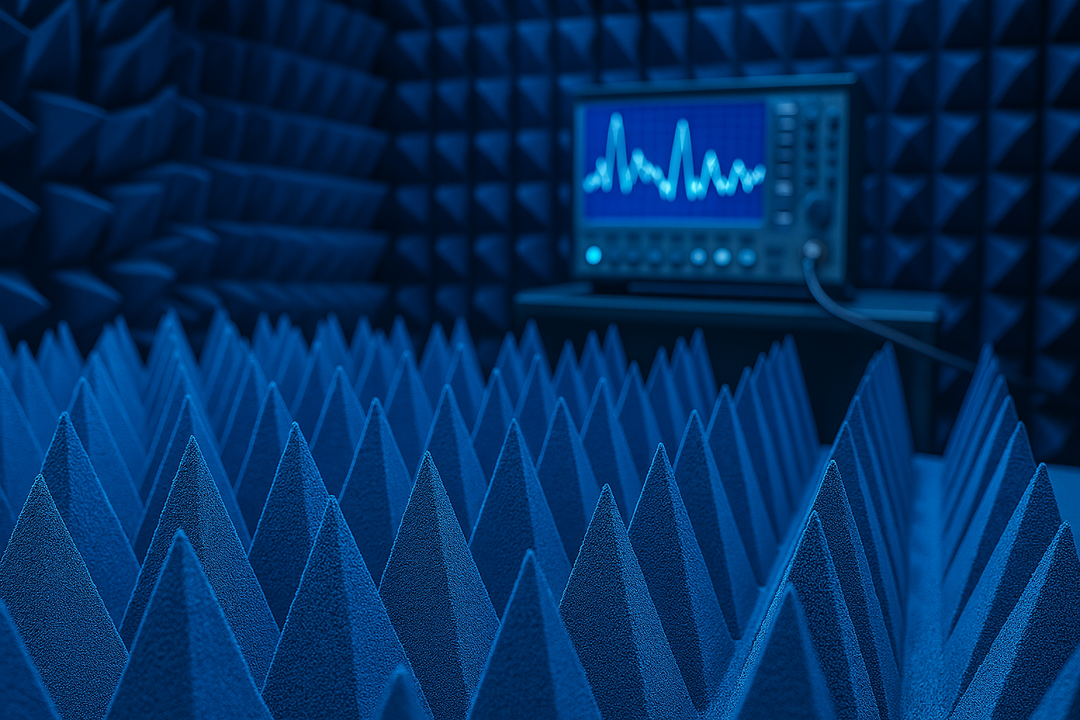
An anechoic chamber isn't a box with panels stuck to the walls for decoration. Every surface – ceiling, floor, side walls, even the space behind the antenna mount – either absorbs incoming energy or bounces it straight back into the test zone.
That second outcome is the problem. A reflected signal shows up in the data as a false ripple or a null that has nothing to do with the antenna being tested. Reflectivity, not raw square footage, is what determines whether a chamber passes muster.
What Actually Drives Reflectivity?
Two things, mainly: the angle at which a wave hits the material, and the wavelength of that signal relative to the material's thickness. RF absorber performs best at normal incidence – a direct hit. At sharper, oblique angles, performance drops, which is why designers often thicken treatment near corners rather than applying one uniform layer everywhere.
Frequency compounds this. Longer wavelengths need physically deeper material to dissipate properly, so a room built for 100 MHz testing looks nothing like one designed only for microwave frequencies.
Calculating the Actual Quantity
This part is mostly measuring, not modeling. Four steps cover it:
- Measure the interior. Multiply length by width for the floor and ceiling, then height by each wall dimension for the remaining four surfaces. Add everything together for a gross total.
- Subtract the openings. Doors, vent panels, and cable pass-throughs won't be covered, and a shielded door alone can account for a real chunk of wall area.
- Add a margin. Ten to fifteen percent on top of the net area covers trim waste, corner cuts, and the adjustments that come up once installation actually starts.
- Match thickness to frequency. The lowest frequency the chamber needs to support decides how deep the pyramidal structures need to be – not the square footage.
Skipping any one of these steps tends to surface later, usually as an unplanned reorder mid-installation.
A Quick Reference for Thickness Planning
| Lowest Test Frequency | Typical Pyramidal Thickness | Best Suited For |
|---|---|---|
| 30–100 MHz | Hybrid ferrite-foam or 72" foam | EMC pre-compliance, low-frequency emissions |
| 200–500 MHz | 24"–48" pyramidal foam | General EMC and antenna pattern testing |
| 1 GHz and above | 12"–24" pyramidal foam | Microwave and antenna measurement chambers |
Figures vary by manufacturer and mounting substrate, so datasheet performance curves should always confirm the final selection.
Where Wireless Growth Fits Into the Picture
None of this is happening in a vacuum. Cellular IoT connections alone reached roughly 4.5 billion by the end of 2025, according to Ericsson's Mobility Report. Every one of those device categories needs EMC or antenna testing at some point before it reaches a shelf.
That volume puts real pressure on test facilities to keep chambers accurate and compliant, not just built. A chamber sized correctly the first time keeps pace with that demand instead of falling behind it.
Power and Application Still Matter
Two details often get overlooked once the area math is settled:
- Power handling. High-power emissions testing needs absorber rated for that power density; standard foam risks thermal damage under sustained high-power exposure.
- Application fit. A pre-compliance test area can often use thinner, less expensive absorbers than a fully certified compliance chamber, where measurement accuracy has to hold up under audit.
Pro Tip: Reflectivity requirements should be checked against the target quiet zone specification before ordering – a chamber meant to resolve pattern features 25 dB below peak needs an absorber that clears that number comfortably, not just barely.

Getting the Material Right, Not Just the Amount
The surface area answers "how much." Geometry and consistency answer "how well it actually performs." Pyramidal foam remains the standard for full and semi-anechoic chambers because its tapered shape lets energy dissipate gradually instead of bouncing straight back.
Not every batch of foam behaves identically, though. Inconsistent RF absorber material between production runs introduces uncertainty no area calculation can fix, and fire-safety compliance becomes non-negotiable for chambers installed in occupied buildings.
This is where dB Absorber comes in. The company supplies pyramidal RF absorbing material engineered for both standard chamber layouts and custom retrofit projects, with documented performance curves available before any order is placed – useful for teams sizing a new chamber or replacing aging panels without wanting to guess twice. Reaching out with actual room dimensions and target frequency range typically gets a faster, more accurate quote than working from a generic catalog size.
Frequently Asked Questions
How much RF absorber material does a typical EMC chamber need?
It depends entirely on interior surface area and lowest test frequency, so there's no universal number. A mid-sized chamber built for 200 MHz to 1 GHz testing commonly needs several hundred square meters of coverage across walls, ceiling, and floor, plus the 10–15% margin described above.
Does thicker RF absorber material always mean better performance?
Not necessarily – thickness needs to match the target frequency rather than being maximized across the board. Over-thick material at high frequencies adds cost and consumes usable chamber volume without improving reflectivity meaningfully.
Can RF absorber material be reused if a chamber is rebuilt or relocated?
Sometimes, provided the foam shows no fire damage, compression, or degradation from age. Reused panels should still be checked against current reflectivity specs, since foam performance can shift slightly over years of use.
What's the difference between RF absorber material and RF absorbing material in datasheets?
The terms are generally used interchangeably across manufacturer literature and industry documentation. Both refer to the same category of lossy, tapered material designed to convert incoming electromagnetic energy into heat.
How long does pyramidal foam typically last in an active chamber?
Most well-maintained installations get well over a decade of reliable service, though exposure to high humidity or physical damage can shorten that. Periodic reflectivity checks are the more reliable way to judge remaining performance than age alone.
Is custom-cut RF absorber material worth the added cost over standard panels?
For non-standard room dimensions or retrofit projects, usually yes – custom cuts reduce seams and gaps that standard panel sizes can't avoid. The reduced waste and improved corner coverage often offset the higher per-unit cost over the life of the installation.