RF Anechoic Chamber Guide: Spec Sheet & Buyer Checklist (2026)

RF Anechoic Chamber Spec Sheet & Buying Checklist (2026)
Roughly 3 billion mobile broadband subscriptions worldwide are now running on 5G networks, according to the International Telecommunication Union's Facts and Figures 2025 report, with 5G coverage reaching 55% of the global population this year. Every one of those devices had to pass through a lab before it reached a shelf, and most of those labs depend on one piece of infrastructure to do it: the RF anechoic chamber.
That number matters because it explains why demand for accurate, well-built test chambers keeps climbing. More frequency bands, more device categories, more compliance checkpoints – all of it funnels back to a room that has to behave like a controlled, echo-free environment every single time.
What Is an RF Anechoic Chamber?
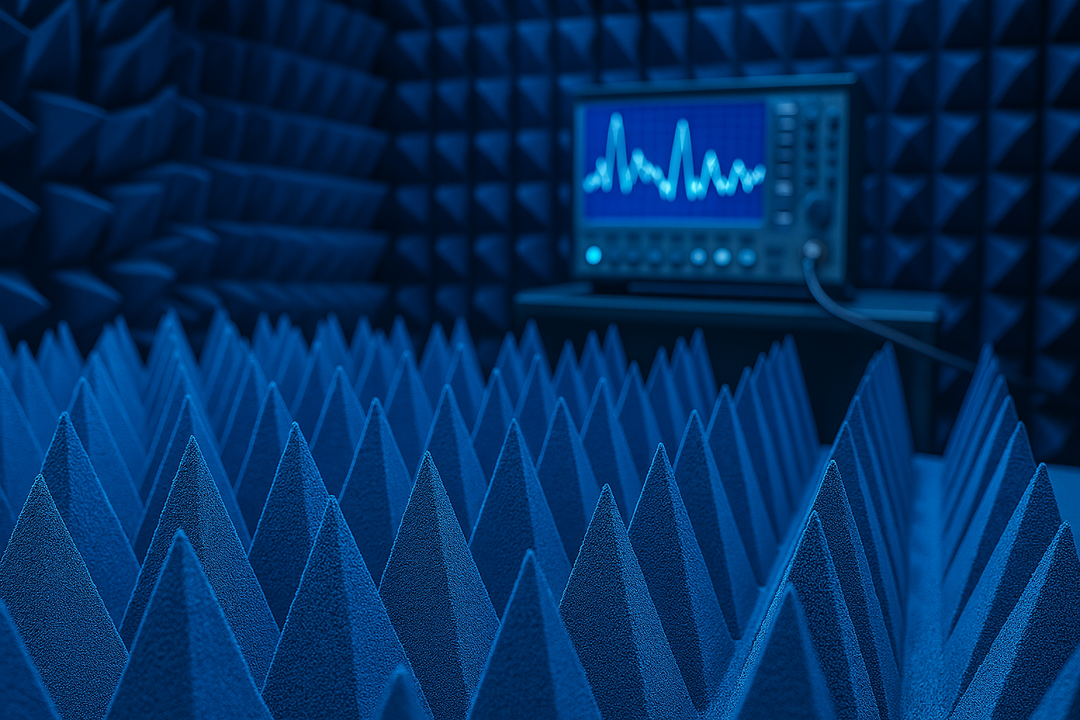
An RF anechoic chamber is a shielded room engineered to do two jobs at once: block outside signals from entering, and stop internal transmissions from bouncing off the walls. The name comes from "anechoic," meaning without echo – no reflections, no interference, just a clean signal path.
Where These Chambers Get Used
The application list is broader than most people expect. A few common examples:
- EMC compliance testing – confirming devices meet FCC, CE, or CISPR emission limits
- Antenna pattern measurement – mapping gain and directivity without wall interference
- Over-the-air (OTA) testing – measuring total radiated power for Wi-Fi, Bluetooth, and 5G devices
- Radar cross section (RCS) testing – assessing how detectable an object is to radar systems
Radio frequency devices sold or imported into the United States must go through this kind of authorization process before they reach the market, a requirement laid out directly by the FCC's Office of Engineering and Technology. That's the regulatory reality driving most of the demand described above – no chamber, no clean test data, no certification.
Why Absorber Choice Decides Everything
A chamber's shielding can be flawless and the results will still be wrong if the wrong absorber lines the walls. This is where a lot of buying decisions quietly go off track.
What Makes Pyramidal Foam Absorbers the Default Choice?
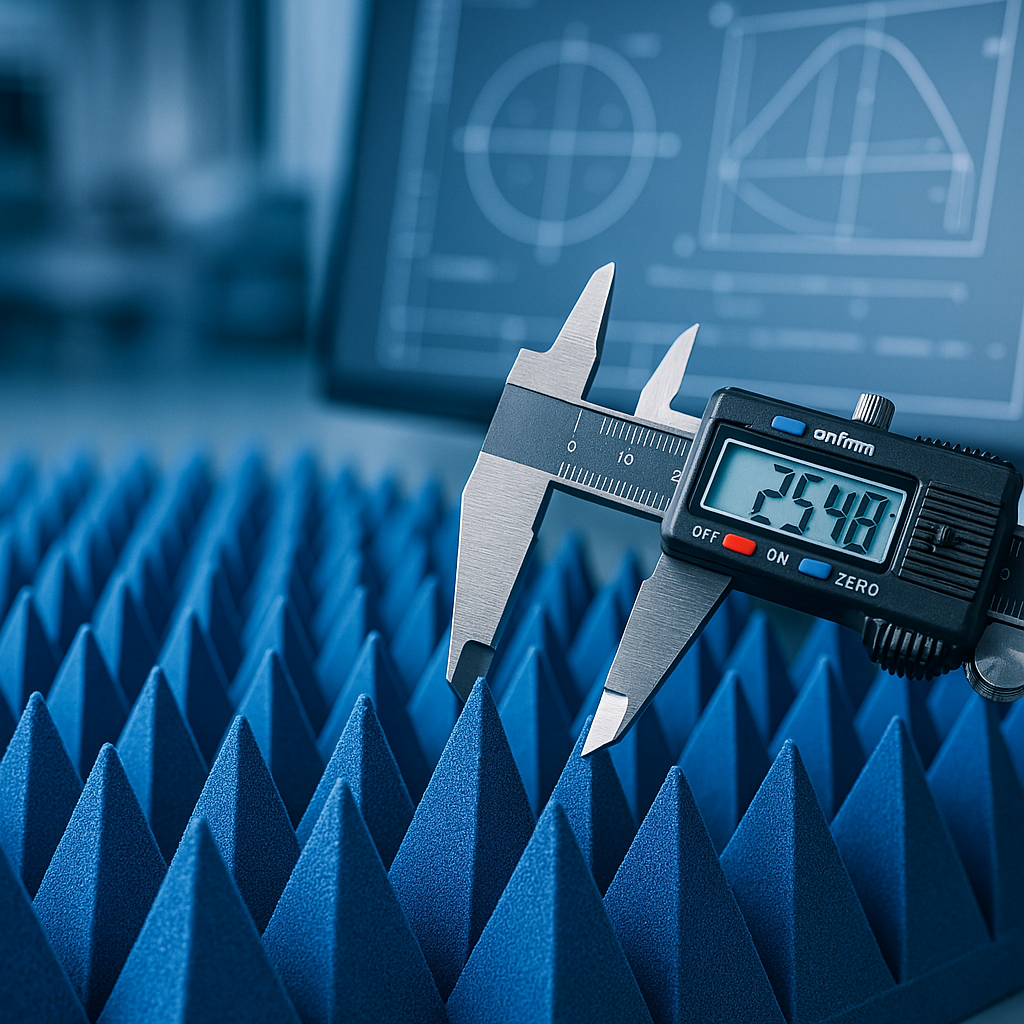
Pyramidal foam absorbers handle broadband frequencies – roughly 1 GHz up to 40+ GHz – better than almost any alternative on the market. The pyramid shape scatters incoming energy across multiple internal reflections instead of bouncing it straight back, which is exactly what a quiet zone needs to stay quiet.
Pro Tip: For chambers built around 5G mmWave testing (24 GHz–100 GHz), request third-party reflectivity data – not just manufacturer specs – before signing off. Some absorbers rated for high frequencies don't hold up under independent measurement.
Ferrite tiles cover the lower end (30 MHz–1 GHz) and take up less space, but they lose effectiveness above 1 GHz. A quick comparison:
| Absorber Type | Effective Range | Best Suited For |
|---|---|---|
| Pyramidal Foam | 1 GHz – 40+ GHz | Antenna, OTA, radar testing |
| Ferrite Tile | 30 MHz – 1 GHz | Low-frequency EMC compliance |
| Hybrid (Ferrite + Foam) | 30 MHz – 18 GHz | General-purpose EMC labs |
The trade-off with pyramidal foam is depth – it needs more physical space than flat or wedge absorbers. Most labs find that trade worthwhile once broadband performance is on the line.
How Long Does Foam Absorber Last?
Ten to fifteen years under normal conditions, though heavy high-power testing shortens that window. Budgeting for eventual panel replacement avoids a nasty surprise when reflectivity quietly starts creeping upward.
Sizing the Quiet Zone Without Overspending
The quiet zone is the usable core of the chamber where field uniformity meets accuracy requirements. As a general rule, it should measure at least three times the longest dimension of the device under test.

Here's a detail buyers often miss: better absorber performance can shrink the required quiet zone margin. A high-reflectivity pyramidal foam panel sometimes allows a smaller overall chamber than a weaker absorber would need for the same accuracy target. That's a conversation worth having with a supplier before assuming a bigger room is the only fix.
Shielding Effectiveness and Its Weakest Links
Shielding effectiveness (SE) measures how well a chamber blocks outside interference, expressed in decibels. Commercial EMC labs typically target 80–100 dB; defense applications often need 100–120 dB or higher.
The absorber can be excellent and the chamber can still underperform if these three areas aren't handled carefully:
- Door seams – knife-edge designs with beryllium copper finger stock hold up better over time than compression-fit doors
- Cable penetrations – every bulkhead entry is a potential leak point regardless of wall lining quality
- HVAC ports – need cutoff waveguides to manage heat without compromising shielding
Why Do RF Doors Fail So Often?
Finger stock wears down from repeated opening and closing, and that wear degrades SE gradually rather than all at once – which makes it easy to miss until a test starts producing odd results. Asking a vendor about maintenance schedules and replacement part availability upfront is a reasonable, low-effort safeguard.
Choosing a Vendor: What Actually Matters
Track record tends to say more than a spec sheet. A few questions worth asking before signing anything:
- How many chambers has the vendor built for comparable frequency ranges?
- Can they provide reference labs willing to speak to long-term performance?
- What's the warranty period on absorber panels specifically?
- How fast can they supply replacement finger stock or absorber sections?
A vendor that manufactures pyramidal foam absorbers directly (rather than reselling generic stock from a third party), usually offers more consistent lead times and better reflectivity documentation, since the material and the data behind it come from the same source.
Ready to Spec the Right Absorber?
A chamber is only as reliable as the material lining its walls. Labs planning a new build, a retrofit, or a panel replacement can get a pyramidal foam absorber recommendation built around actual frequency range, quiet zone size, and testing standards – not a generic catalog panel. Reach out to db Absorber with those three details on hand and get a spec that fits the application from the start.
Frequently Asked Questions
What's the difference between a fully anechoic chamber and a semi-anechoic chamber?
A fully anechoic chamber has absorber on all six surfaces. A semi-anechoic chamber keeps a reflective floor with absorber on the walls and ceiling, typically for EMC testing where a ground plane is required.
What frequency range should a chamber cover?
It depends entirely on the application. EMC labs commonly work across 30 MHz–18 GHz, while 5G and radar testing can push requirements up to 40–110 GHz.
Can an existing room be converted into an RF anechoic chamber?
Yes, provided the structure can support proper shielding and absorber installation. Many labs find a modular chamber build more cost-effective than retrofitting an existing space.
How is chamber performance verified after installation?
Through standardized measurements – normalized site attenuation (NSA) and site VSWR for EMC chambers, quiet zone reflectivity testing for antenna chambers, and shielding effectiveness testing per IEEE Std 299.