Top 7 EMI Shielding Materials for Anechoic Chambers

Top 7 Must-Know EMI Shielding Materials for Anechoic Chambers
Choosing the wrong EMI shielding materials for an anechoic chamber doesn't just hurt test accuracy – it can mean a failed compliance audit, costly retrofits, and delayed product launches. The materials lining a chamber's shell and inner walls determine everything: frequency coverage, absorption uniformity, long-term reliability, and whether the finished enclosure meets CISPR, FCC, or MIL-STD standards from day one.
This guide breaks down the seven core electromagnetic shielding materials used in modern anechoic chambers – what each one does, where it belongs, and what to watch for when specifying or purchasing.
What Makes an Anechoic Chamber Actually Work?
An anechoic chamber has two separate jobs, and most performance problems start when engineers treat them as one.
Job one: Block external electromagnetic energy from entering the test space. Job two: Absorb internal reflections before they corrupt measurements. These roles require entirely different EMI EMC shielding materials – metal panels for the outer shell, absorptive linings for the interior surfaces. Getting both right is what separates a chamber that passes site validation from one that doesn't.
Shell vs. Lining – Why the Distinction Matters
The outer shell reflects and attenuates incoming electromagnetic waves. The inner lining converts wave energy to heat, preventing it from bouncing back toward the antenna under test. Some materials can partially serve both roles, but most are optimized for one function.
Mixing up these roles – or skimping on one to save budget – is the most common reason chambers underperform during qualification testing.
The 7 Core EMI Shielding Materials, Explained
Each material below serves a specific structural or absorptive function. Understanding which role each plays helps avoid over-specifying in some areas and under-specifying in others.
1. Galvanized Steel Panels
Galvanized steel is the default choice for the main enclosure. 2–3 mm modular pan-type panels achieve shielding effectiveness exceeding 100 dB across 14 kHz to 40 GHz – broad enough to cover virtually every modern EMC test scenario.

Steel's magnetic permeability makes it especially effective against low-frequency magnetic fields. The zinc coating prevents corrosion, and modular panel construction allows chambers to be dismantled and reassembled without losing structural integrity – provided joint quality is maintained throughout.
Pro Tip: Copper wool and conductive tape at every hat and flap joint aren't optional extras. Skipping them creates seam leakage that degrades shielding effectiveness in ways that are difficult to diagnose after installation.
2. Copper Foil and Sheets
Copper delivers exceptional attenuation of both magnetic and electric field waves, making it the top-performing EMI shielding material by conductivity. It's typically chosen for MRI-adjacent chambers, small high-precision enclosures, or situations where steel's performance at mid-to-high frequencies isn't sufficient.

The trade-off is cost. Copper is substantially more expensive than galvanized steel per square meter of coverage – which is why it's common in bespoke or research builds rather than standard commercial EMC labs.
3. Ferrite Tiles
Ferrite tiles are the standard solution for absorbing electromagnetic energy below 1 GHz. They work by converting incident wave energy into heat through magnetic losses, with absorption levels ranging from 10 dB to 25 dB across the 30 MHz to 1 GHz range.

Tiles are mounted on wood spacers before being screwed into the chamber's shielding panels. That wood layer isn't just structural – it acts as a dielectric spacer that creates a capacitive effect, which is part of what gives ferrite tiles their low-frequency absorption characteristics.
Key specifications to check when sourcing ferrite tiles:
- Tile size: The industry standard is 100 mm × 100 mm; larger 200 mm tiles are available for faster installation
- Dimensional tolerance: Tight tolerances reduce gaps between tiles, which are a measurable source of performance degradation in CISPR 16-1-4 compliance chambers
- Temperature rating: Sintered ceramic ferrite tiles handle high-power and high-temperature applications up to the Curie point (\~203°F / 95°C)
4. Pyramidal Carbon-Loaded Foam Absorbers
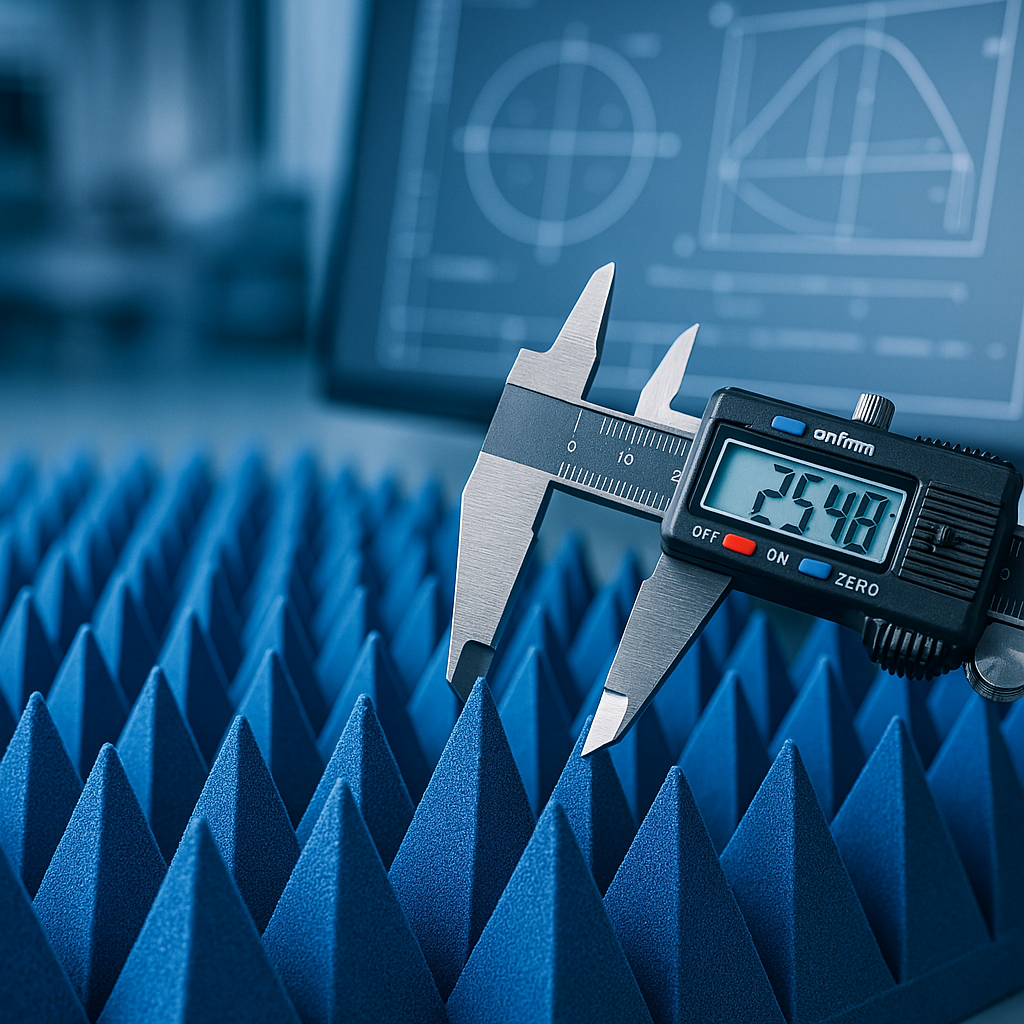
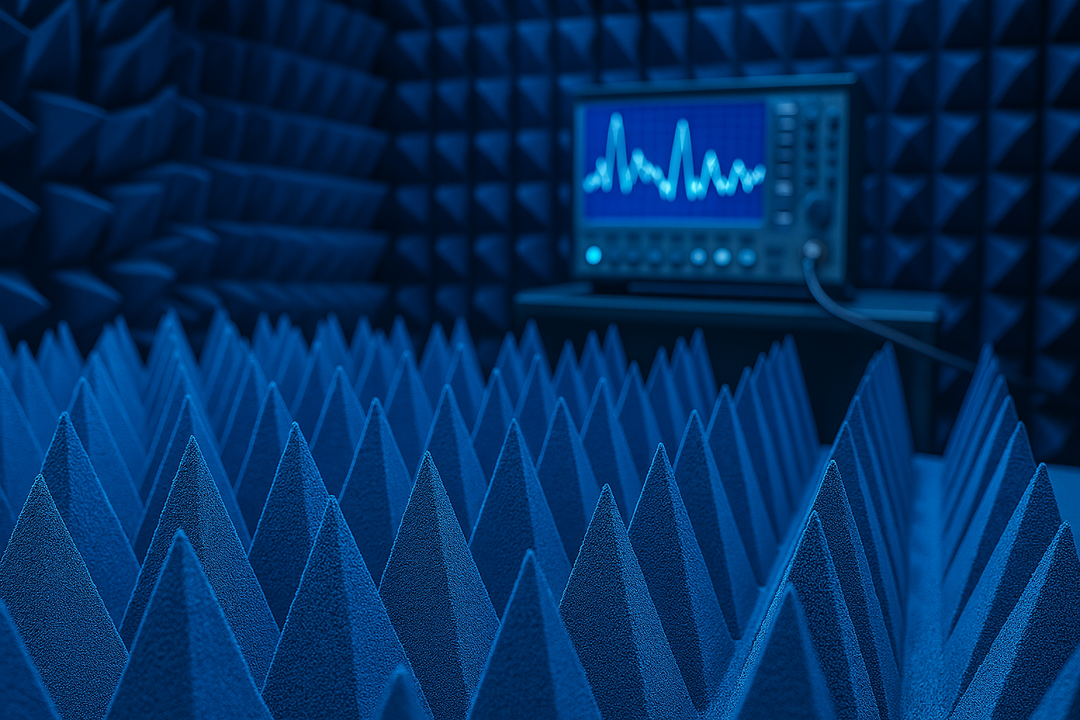
This is the material that makes or breaks high-frequency chamber performance. Carbon-impregnated low-density polyurethane foam absorbers provide broadband absorption reaching up to 40 GHz, covering the frequency ranges used in 5G, automotive radar, and satellite communications testing.

The pyramid shape is functional, not decorative. It creates a gradual impedance transition from free space to the conductive foam surface – reducing reflections far more effectively than a flat absorber face could. Pyramid height determines the lowest effective frequency: taller pyramids absorb lower frequencies but consume more interior volume. A minimum height of 300–600 mm is typical for useful performance above 200–300 MHz.
For labs running compliance testing above 1 GHz, pyramidal RF absorbers are the non-negotiable interior lining. DB Absorber specializes in precisely this product category – engineered for consistent, broadband attenuation across the frequencies that wireless device compliance testing demands. Browse DB Absorber's pyramidal absorber range to compare specifications for your chamber build.
5. Hybrid Absorbers
No single material covers the full frequency range of a modern EMC chamber. Hybrid absorbers solve this by layering ferrite tiles with foam pyramids – ferrite handles low-frequency absorption, foam takes over above 1 GHz. Most CISPR 25 chambers use this hybrid configuration, delivering broadband coverage from 30 MHz to well above 2,500 MHz.

The practical advantage beyond frequency range: hybrid-lined chambers retain more usable interior volume than chambers relying on tall standalone foam pyramids for low-frequency coverage. That matters in 10-meter chambers where test distances are fixed by the applicable standard.
6. Aluminum Panels
Aluminum is chosen where structural load limits or weight constraints rule out steel – aerospace-adjacent environments, portable enclosures, or lightweight test facilities. It's non-ferrous and non-magnetic, with reasonable conductivity across mid-to-high frequencies.

That said, aluminum has real limitations as an EMI shielding material: it lacks the magnetic permeability of steel, which means weaker attenuation at low frequencies. Oxidation at panel joints degrades electrical contact over time, and galvanic corrosion is a genuine risk wherever aluminum contacts dissimilar metals. These aren't reasons to avoid it – but they're reasons to plan maintenance carefully.
7. Conductive Gaskets and Honeycomb Vents
Every penetration in a chamber shell – power cables, ventilation ducts, doors – is a potential weak point. Conductive gaskets made from silicone filled with conductive metal particles seal seams and door frames, maintaining electrical continuity through repeated open-close cycles.

Honeycomb ventilation panels solve the ventilation problem using geometry: their waveguide-below-cutoff design allows airflow while blocking RF signals from passing through.
Matching Materials to Frequency Range
Selecting the right combination of EMI shielding materials follows directly from the chamber's target frequency range and the standards it needs to meet.
| Material | Primary Role | Effective Frequency Range |
|---|---|---|
| Galvanized steel panels | Outer shell shielding | 14 kHz – 40 GHz |
| Ferrite tiles | Low-frequency absorption | 30 MHz – 1 GHz |
| Pyramidal foam absorbers | High-frequency absorption | 200 MHz – 40 GHz |
| Hybrid absorbers | Broadband absorption | 30 MHz – 2.5 GHz+ |
Most production EMC chambers pair galvanized steel panels with a hybrid absorber interior. Chambers designed for narrow high-frequency bands – radar testing above 10 GHz, for example – may skip ferrite entirely and rely on foam geometry alone.
Why Pyramidal Foam Absorber Quality Varies So Much
Of all the electromagnetic shielding materials in a chamber, pyramidal foam absorbers show the widest quality variation between suppliers. Carbon loading distribution throughout the foam is the critical variable. Uneven carbon density creates zones of higher reflectivity – hot spots that show up as measurement variance during site validation and are expensive to diagnose and correct after installation.
Fire retardancy is the other factor that separates compliance-grade absorbers from lower-cost alternatives. Absorbers meeting NRL-8093 fire retardancy standards are the accepted benchmark for regulated test environments.
The geometry question – pyramid vs. wedge vs. convoluted profile – depends on the angle of incidence the chamber needs to handle:
- Standard pyramids: Optimized for normal incidence; the default choice for most EMC and radiated emissions testing
- Wedge absorbers: Better performance at oblique angles; common in radar cross-section (RCS) measurement chambers
- Convoluted foam: Good broadband performance in compact spaces; useful for smaller enclosures or equipment testing bays
Ready to Specify the Right Absorbers for Your Chamber?
Getting the material specification right before construction is far less expensive than retrofitting after a failed site qualification. The combination of outer shell material, absorber type, and penetration sealing needs to match the chamber's target frequency range and the applicable compliance standard – not just a general-purpose spec sheet.
DB Absorber works directly with EMC labs, test facility designers, and RF engineers to match pyramidal foam absorber specifications to exact chamber geometries and compliance requirements.
FAQ: EMI Shielding Materials for Anechoic Chambers
What is the most common EMI shielding material for the outer shell of an anechoic chamber?
2 mm galvanized steel panels are the industry standard, achieving over 100 dB of shielding effectiveness across 14 kHz to 40 GHz. Copper foil is used in specialized applications where higher conductivity is required.
What is the difference between ferrite tiles and foam absorbers?
Ferrite tiles absorb electromagnetic energy at lower frequencies (30 MHz – 1 GHz) through magnetic losses. Foam pyramid absorbers handle high-frequency attenuation (above 200 MHz, up to 40 GHz) through a gradual impedance transition. Most full-compliance chambers use both in a hybrid configuration.
How do pyramidal absorber dimensions affect chamber performance?
Taller pyramids absorb lower frequencies. A 300–600 mm pyramid height is typical for performance above 200–300 MHz. Choosing the wrong height for the target frequency range results in insufficient absorption and failed site qualification.
Are all pyramidal foam absorbers fire-retardant?
Not automatically. Compliance-grade chambers require absorbers meeting NRL-8093 fire retardancy standards. Always verify this specification before purchasing for a regulated test environment.
Can one EMI shielding material cover the full frequency range of an anechoic chamber?
No. Broadband coverage from 30 MHz to 40 GHz requires a layered system – galvanized steel or copper for the shell, ferrite tiles for low-frequency absorption, and pyramidal foam absorbers for high-frequency performance.