The Ultimate Guide to Microwave Absorbers: Types & Applications

The Ultimate Guide to Microwave Absorbers: Types, Applications, and Performance
Electromagnetic interference is a quiet but persistent problem. Radar systems pick up ghost targets. 5G devices talk back to themselves. Stealth aircraft show up on screens they shouldn't. In every one of these cases, microwave absorbers are the solution — specialized materials that convert electromagnetic energy into heat instead of letting it bounce around and cause trouble.
This guide breaks down what these materials are, which types exist, and where they're actually used.
How Microwave Absorbers Actually Work
Not all materials interact with electromagnetic waves the same way. What absorbs microwaves is determined by two key properties: permittivity (how a material responds to electric fields) and permeability (how it responds to magnetic fields). Engineers load base materials — rubber, foam, plastic — with dielectric or magnetic fillers to tune these properties and achieve useful attenuation at target frequencies.
The goal in every case is the same: minimize reflection, maximize heat dissipation.
Two Core Design Approaches
There are two main ways to build microwave absorbers, and they work on completely different principles.
Resonant absorbers, like the classic Salisbury Screen, place a thin resistive sheet one-quarter wavelength above a metal ground plane. Reflected waves from both surfaces cancel each other through destructive interference, achieving absorption exceeding 30 dB at the design frequency. The tradeoff is narrow bandwidth and greater thickness at lower frequencies.
Graded-dielectric absorbers take a different path. Instead of cancellation, they gradually shift the impedance from open air to a highly lossy medium — so incoming waves ease into the material rather than hitting a sharp boundary. Research published in the Journal of Applied Physics confirms that convoluted absorbers using this approach can reach 50 dB absorption at normal incidence, particularly in the millimeter-wave range.
A Breakdown of the Main Absorber Types
The range of commercially available microwave absorbers is wider than most people expect. Each type is built around a different set of tradeoffs — thickness, weight, frequency coverage, flexibility, and environmental durability.
Here's a quick overview of the main categories:
- Magnetic absorbers — loaded with carbonyl iron or ferrites; thin and effective at lower frequencies
- Dielectric (carbon-based) absorbers — use carbon black, graphite, or carbon nanotubes; common in foam form
- Elastomeric sheet absorbers — flexible rubber-based sheets with excellent environmental resistance
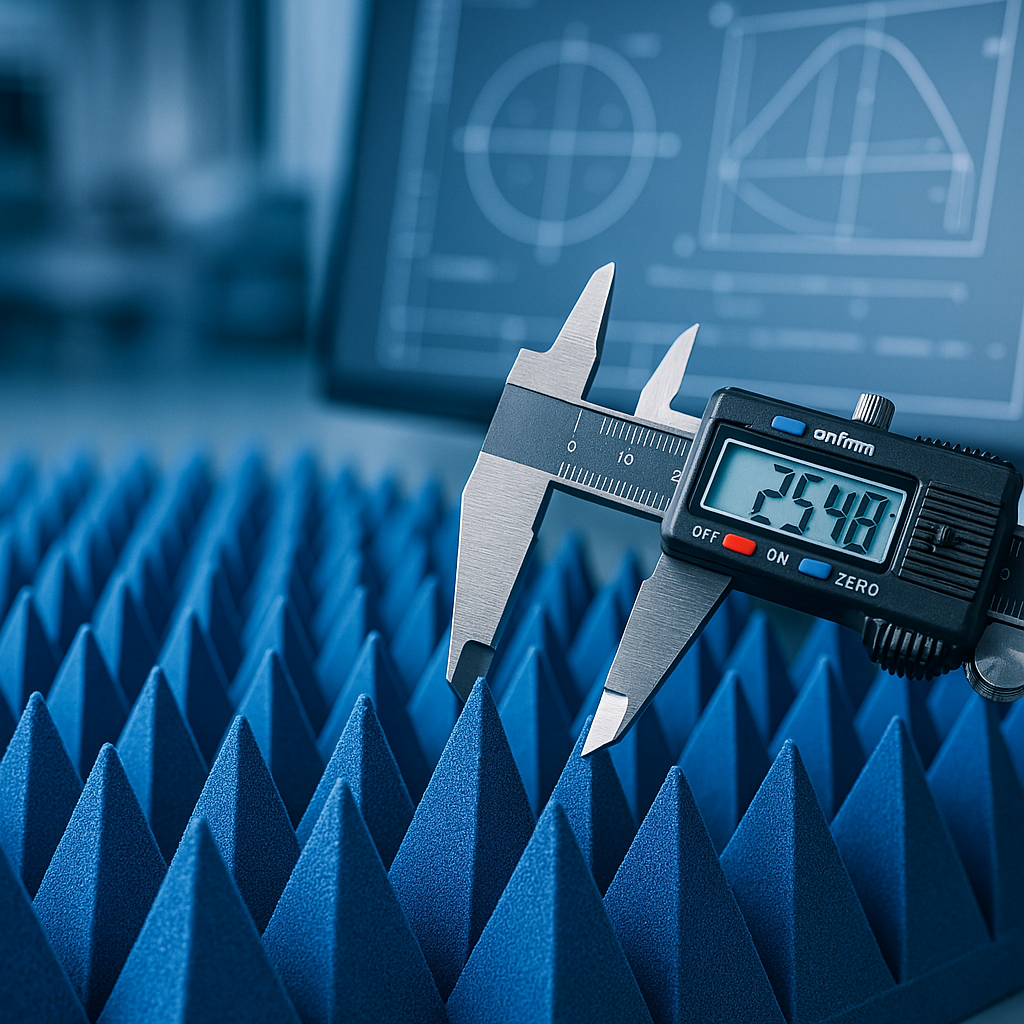
- Foam absorbers — pyramidal or convoluted carbon-loaded polyurethane; the standard in anechoic chambers
- Honeycomb absorbers — lightweight structures for high-power aerospace applications
- Jaumann absorbers — multilayer designs that broaden bandwidth through interference effects
- Split-ring resonators (SRR) — printed or etched narrowband structures tuned to specific radar frequencies
Magnetic vs. Dielectric: What's the Real Difference?
The most fundamental distinction among materials that absorb microwaves comes down to what they act on — the magnetic field or the electric field.

Magnetic absorbers use high-permeability fillers, most commonly carbonyl iron powder and ferrites, to dissipate energy through magnetic loss. They perform especially well at lower frequencies and can be made very thin. An elastomeric absorber loaded with carbonyl iron can be up to 75% thinner than a Salisbury Screen design tuned to the same frequency — which matters considerably in aerospace and naval applications where space is tight.
Dielectric absorbers use carbon-based fillers to interact with the electric field. Broadband foam versions can cover 2 GHz to 18 GHz and above at around 1.25 inches thick — reliable performance for lab environments where ruggedization isn't the priority.
Elastomeric Sheets: Built to Last
Rubber-based absorbers have been bonded to surface ships for over 50 years. That track record says something. The elastomer matrix can be nitrile for fuel and oil resistance, Hypalon for weathering and color stability in naval environments, or silicone for extended temperature ranges. Most are applied via adhesive bonding to metal substrates, with pressure-sensitive adhesives common in electronics and epoxy systems used for structural bonds.
Dual-band elastomeric absorbers are particularly capable. By controlling layer thickness and filler loading precisely, it's possible to tune two discrete resonant frequencies simultaneously — achieving greater than 15 dB absorption across an octave of bandwidth, something a single-layer resonant design simply can't match.
Where These Materials Are Actually Deployed
The application space for microwave absorbers runs across both military and commercial sectors. As commercial electronics have pushed into higher frequencies, that line has blurred considerably.
Defense and Aerospace
In defense applications, radar cross-section (RCS) reduction is the headline use. Aircraft, ships, and missiles use absorbers to convert incoming radar energy to heat rather than scattering it back toward the source. Tuned elastomeric absorbers bonded to naval masts and superstructures can reduce false radar echoes by up to 40 dB — the difference between reliable navigation and a system chasing phantom targets.
Anechoic chambers for antenna and radar testing are lined entirely with microwave absorbers to eliminate reflections. Without effective absorption, clean measurements aren't possible.
Commercial Electronics and Automotive
The growth of 5G infrastructure, wireless LAN, and autonomous vehicle radar has created steady demand for microwave absorbers inside electronic enclosures. Thin magnetic absorber sheets — die-cut to custom shapes with adhesive backing — are now standard inside 5G base stations, routers, and network servers. They suppress internal cavity resonance that would otherwise degrade signal quality.
RFID tags mounted near metal surfaces lose read range because the metal detunes the antenna. A thin magnetic absorber layer between the tag and the substrate restores it. Automotive radar sensors face a similar challenge — adjacent sensors interfere with each other, and absorbers are what keep those signals isolated.

Performance: The Numbers That Drive Selection
Three metrics matter most when evaluating microwave absorbers.
Reflection loss (RL), measured in decibels, is the most direct measure of how much energy was absorbed. A result of -20 dB means 99% absorption; -30 dB means 99.9%. For most practical applications, -20 dB is the accepted minimum threshold.
Bandwidth determines usefulness across real-world conditions. Narrowband absorbers hit very high RL at a single frequency but drop off sharply on either side. Broadband types spread performance across 2 to 18 GHz or beyond, at somewhat lower peak absorption and typically greater thickness.
Environmental resistance completes the picture. Most standard elastomeric absorbers are rated from -65°F to 250°F, with silicone-based materials pushing that ceiling higher for extreme heat applications.
The central tradeoff in absorber design — better performance requires more material, which means more weight and thickness — is the target of active nanocomposite research. Studies on three-dimensional graphene composites and carbon nanotube/ferrite hybrid systems are working toward thinner, lighter materials that absorb microwaves with broader bandwidth — potentially changing the core tradeoff that has defined this field for decades.
Summary
Choosing the right absorber becomes straightforward once the requirements are clearly defined. Frequency range, reflection loss targets, angle of incidence, form factor, and operating environment — answer those questions, and the right material class becomes obvious. The diversity of available microwave absorbers exists precisely because the requirements are so varied. No single design covers every scenario, and the best results always come from matching the material to the specific job.