The Quarter Wavelength Rule: How to Size RF Absorber Depth

How to Size RF Absorber Depth: The Quarter-Wavelength Rule
A chamber's absorber panels are rated for 500 megahertz of newly identified federal spectrum between 1.3 GHz and 10.5 GHz that regulators are pushing toward commercial use over the next several years, according to NTIA's spectrum repurposing program. That shift means more devices, more test labs, and more anechoic chambers built or rebuilt to handle frequencies that didn't matter much five years ago. None of that expansion works without one calculation sitting quietly behind every absorber spec sheet: the quarter wavelength rule.
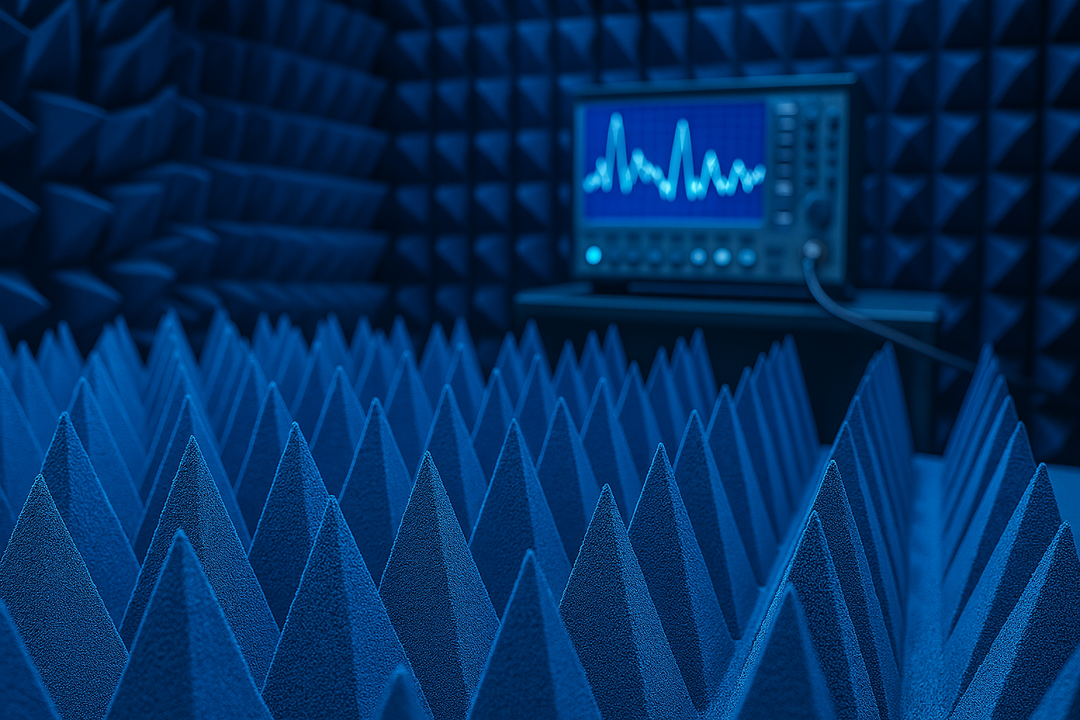
Anyone responsible for building or upgrading a test chamber runs into this rule sooner or later. Skip it, and reflections creep back into measurements. Follow it correctly, and the chamber does what it's supposed to do – stay quiet across the frequencies a facility actually needs.
What Is the Quarter Wavelength Rule?
The quarter wavelength rule sets the minimum physical depth of an absorber at roughly one-fourth of the wavelength for the lowest frequency a chamber needs to handle. In formula terms: d \= λ / 4, where d is depth and λ is wavelength.
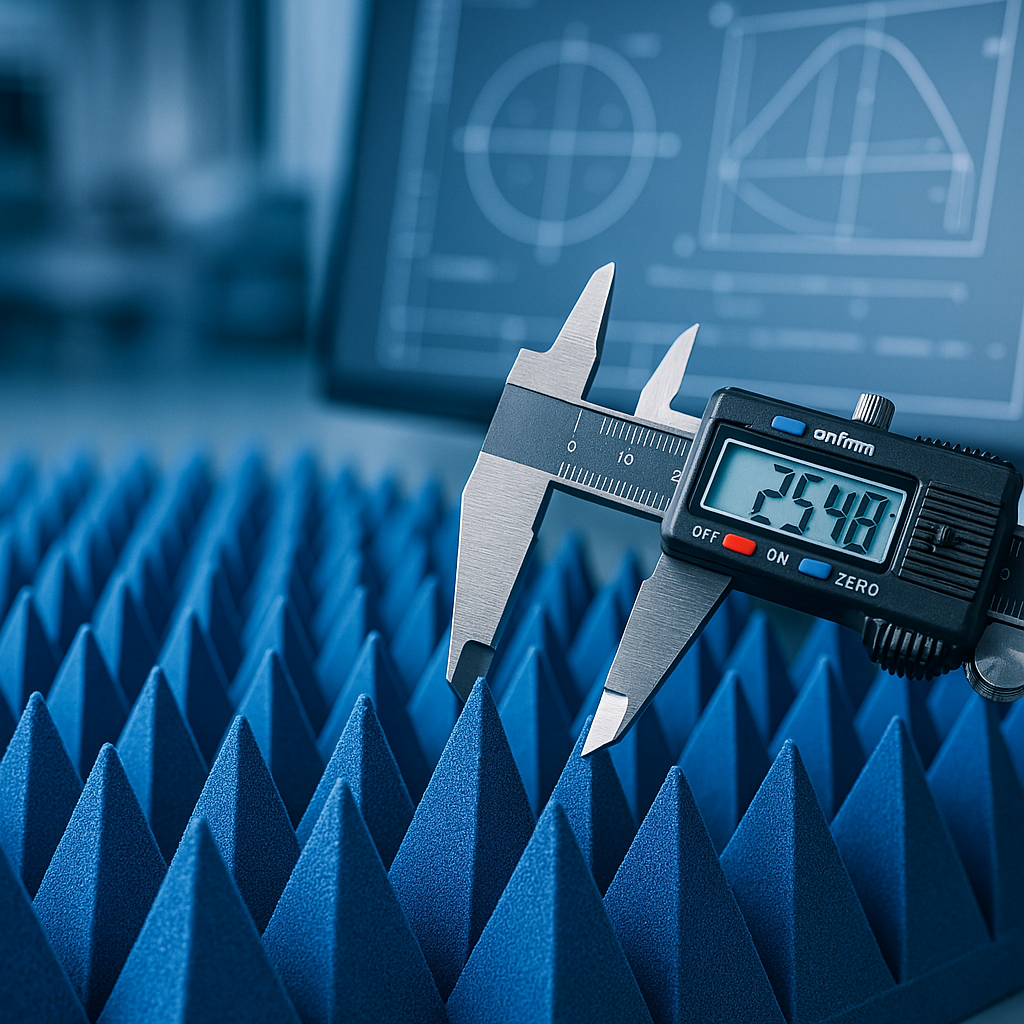
This isn't a theoretical nicety. It's the single number that determines whether an RF pyramidal absorber panel will actually suppress reflections at a facility's lowest test frequency, or simply look at the part while letting energy bounce straight back.
Why Depth, Not Density, Comes First
Density and carbon-loading affect how well an absorber performs. Depth determines whether it can perform at all at a given frequency. A dense, well-formulated foam that's too shallow for its target frequency still reflects a meaningful chunk of incident energy, because the wave simply doesn't have enough material to interact with before reaching the backing wall.
Calculating Absorber Depth Step by Step
Two calculations, done in order, produce a usable number.
- Find the wavelength. Divide the speed of light (c ≈ 3 × 10⁸ m/s) by the lowest target frequency: λ \= c / f.
- Apply the quarter-wave factor. Divide that wavelength by four: d \= λ / 4.
Pro tip: Always calculate against the lowest frequency a chamber will ever realistically test – not just the frequency listed in the current project scope. Retrofitting absorber depth later is far more expensive than sizing it correctly the first time.
A Quick Reference Table
The relationship between frequency and required depth isn't linear in a way most people intuit. Here's how the quarter wavelength rule plays out across common test frequencies:
| Lowest Frequency | Wavelength (λ) | Minimum Depth (λ/4) |
|---|---|---|
| 100 MHz | 3.0 m | \~75 cm |
| 300 MHz | 1.0 m | \~25 cm |
| 1 GHz | 30 cm | \~7.5 cm |
| 10 GHz | 3 cm | \~0.75 cm |
Notice the jump between 100 MHz and 1 GHz. A tenfold increase in frequency cuts the required depth by roughly the same factor – which is exactly why low-frequency chambers end up so much larger, and so much more expensive to line, than high-frequency ones.
Why Pyramidal Geometry Outperforms Flat Panels
Flat absorbing sheets can technically be built to the same depth math. In practice, they underperform tapered shapes at equal thickness, because a flat surface presents an abrupt impedance boundary instead of a gradual one.
Pyramidal geometry solves this by easing the transition. Each tapered spike behaves like a stack of progressively denser layers, so the wave meets increasing resistance gradually rather than all at once. That's the core reason RF pyramidal absorber panels remain the default choice in general-purpose anechoic chambers, decades after the design was standardized.
Where Wedge Absorbers Fit Instead
Wedge-shaped absorbers follow similar physics but are typically reserved for corner placements or grazing-incidence angles, where pyramidal geometry is less efficient. For most flat-wall chamber lining, though, pyramids remain the more cost-effective option per unit of performance.
Where the Math Comes From – And Why It Holds Up
Broadband demand isn't shrinking. The 18 GHz band, studied by NTIA, NASA, and the Department of Defense and confirmed for expanded satellite use following the 2023 World Radiocommunication Conference, is one example of frequency territory that didn't carry serious commercial weight a decade ago. Every band opened for new use eventually needs a test chamber somewhere, and every test chamber needs its absorber depth calculated against the lowest frequency in that band.
Manufacturer spec sheets reflect this even when they don't spell out the formula. A pyramidal panel rated "80 MHz to 18 GHz" wasn't sized arbitrarily – that depth is the direct output of the quarter wavelength rule applied to 80 MHz, then verified through independent reflectivity testing rather than assumed from geometry alone.

When Space Won't Allow for Ideal Depth
Not every facility has room for a meter of foam jutting off the wall. Urban labs, mobile units, and retrofits in older buildings frequently hit a hard ceiling on usable depth, well below what the quarter wavelength rule for RF applications calls for at low frequencies.
A few approaches narrow that gap without fully replacing the physics:
- Hybrid ferrite-foam absorbers extend low-frequency performance in less depth than pure foam alone.
- Denser carbon-loading gradients improve reflectivity incrementally at a fixed thickness.
- Revisiting the lowest required test frequency, where standards permit it, can shrink the calculation substantially – a chamber built for 300 MHz and up needs a fraction of the depth one built for 80 MHz and up requires.
None of these erase the underlying math. They shift where the trade-off lands, which is often enough to make a project workable.
Matching Absorber Choice to Actual Frequency Range
Two pyramidal panels can look nearly identical on a shelf and behave very differently once installed, purely because of depth differences driven by the quarter wavelength rule at their respective low ends. Buyers who compare only the material or the price per panel – without checking the rated low-frequency depth against their own project – sometimes end up with an absorber that's either far more expensive than necessary, or quietly unable to handle frequencies the facility expects to test later.
Choosing Absorber Panels Built to the Right Depth
Sizing depth correctly solves half the problem. The other half is sourcing panels manufactured to consistent density, properly tapered, and backed by reflectivity data that holds up under independent testing rather than a generic catalog claim.
dbAbsorber specializes in exactly this kind of precision – pyramidal foam absorbers engineered and depth-rated against real frequency requirements, not a one-size-fits-all panel pulled off a shelf. Facilities specifying a new chamber, planning a retrofit, or replacing worn tips can work directly with dbAbsorber's team to match RF pyramidal absorber and RF foam absorber configurations to their actual lowest test frequency, with depth calculations grounded in the quarter wavelength rule from the start.
Getting that depth right the first time protects both budget and usable floor space for years of testing ahead – reach out to dbAbsorber for a sizing consultation and product recommendation tailored to the frequency range that matters most.
Frequently Asked Questions
What is the quarter wavelength rule in RF absorber sizing?
It's the standard used to set minimum absorber depth, requiring roughly one-fourth of the wavelength at a chamber's lowest target frequency. Below that depth, incident energy doesn't fully dissipate before reaching the backing surface, and reflections increase. It's the starting calculation behind nearly every pyramidal or wedge absorber spec.
Why do low frequencies need such deep absorbers?
Wavelength grows as frequency drops, and depth is tied directly to wavelength. A 100 MHz signal has a wavelength of about 3 meters, so the quarter wavelength rule calls for roughly 75 centimeters of material – compared to under a centimeter for a 10 GHz signal.
Is a thicker RF foam absorber always better?
Not necessarily. Extra depth rarely hurts performance, but it adds cost and consumes floor space without meaningful benefit at frequencies where the wavelength is already short. Matching thickness to actual test requirements is more efficient than defaulting to maximum depth.
Can hybrid absorbers replace the need for full quarter-wave depth?
They can reduce it, not eliminate it. Combining ferrite tiles with foam pyramids improves low-frequency absorption in less physical space than foam alone, which helps in retrofits and compact chambers, though a hard floor still exists based on target frequency.
How is absorber reflectivity verified beyond the depth calculation?
Reflectivity, usually expressed as return loss in decibels, is measured through independent testing rather than assumed from geometry. Two absorbers built to identical depth can still perform differently depending on tip shape, carbon-loading gradient, and material density.
What happens if a chamber's absorber is undersized for its lowest frequency?
Reflections increase at that frequency, which shows up as measurement inaccuracy – skewed antenna patterns, unreliable EMC results, or inconsistent radar cross-section data. The problem often isn't obvious until testing pushes toward the chamber's rated lower limit, by which point retrofitting is costly.