Radar Absorbing Material: Types, Specs & Selection Guide

Radar Absorbing Material: Types, Specs & Selection Guide
Choosing the wrong radar absorbing material doesn't just affect test accuracy – it can invalidate measurements entirely, delay certification, and force costly chamber modifications. The options look similar on a product page but behave very differently in practice. Frequency range, physical size, fire rating, and installation environment each play a role in determining what actually works.
This guide covers how these materials function, what distinguishes one type from another, and how to make a sound, specification-backed procurement decision.
What Is Radar Absorbing Material and How Does It Work?
Radiation absorbent material (RAM) is engineered to convert incident radio-frequency energy into heat instead of reflecting it back into a space. The physics involves two distinct loss mechanisms:
- Dielectric loss – acts on the electric field component of the wave
- Magnetic loss – acts on the magnetic field component
Most commercially available radar material for anechoic chambers and EMC test facilities relies on one or both mechanisms, depending on the target frequency band. Geometry matters just as much as composition. A pyramidal profile creates a gradual impedance transition between free space and the absorbing foam – a principle known as progressive impedance matching – which is why pyramidal absorbers consistently outperform flat sheets at microwave frequencies.
Radar absorption performance is expressed in decibels of reflectivity:
- –20 dB \= 99% of incident energy absorbed
- –40 dB \= 99.99% absorbed
- –50 dB or better \= the standard for high-performance anechoic chambers
The Four Main Types of Radar Absorbing Material
Each absorber type is built around different physics, and that means different strengths, limitations, and ideal applications. Here's how they compare in practice.

Pyramidal Carbon-Loaded Foam
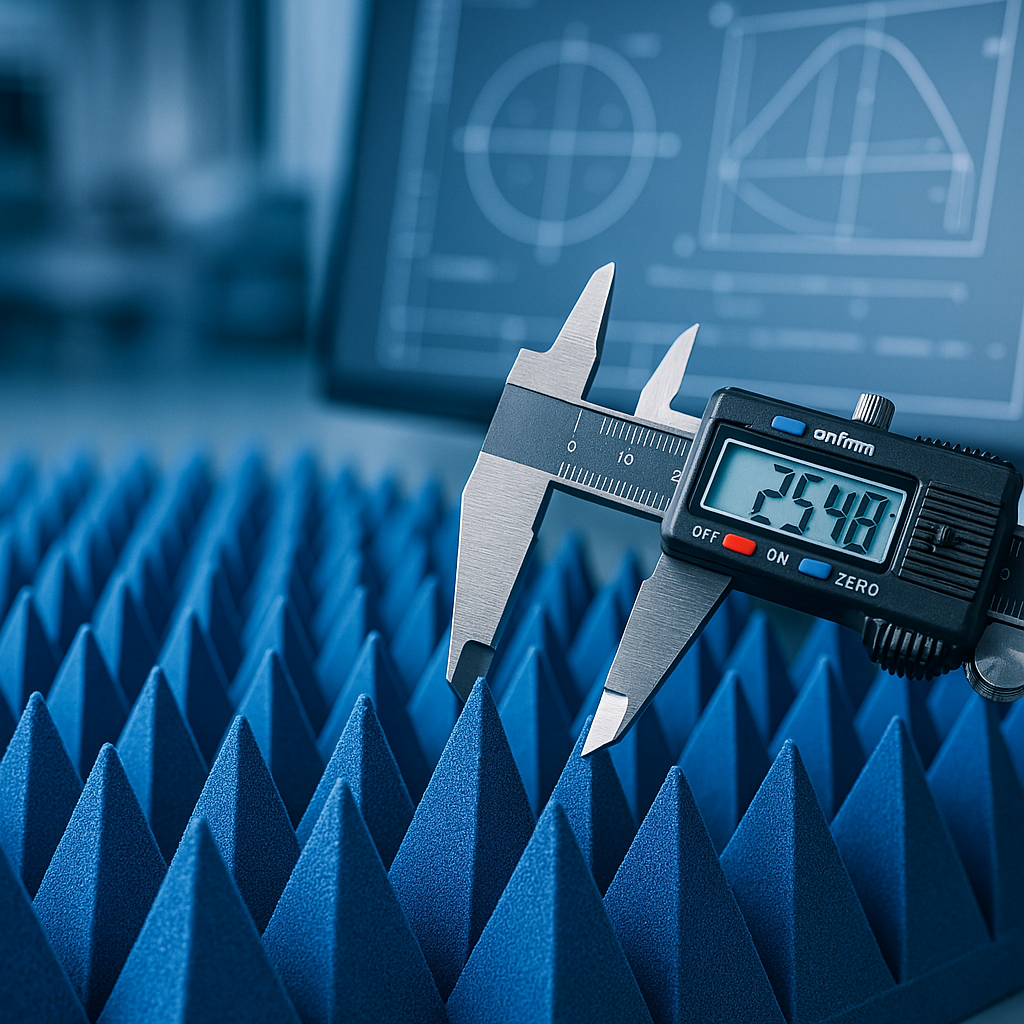
Carbon-loaded polyurethane foam shaped into pyramids is the most widely specified radar absorbing material in commercial anechoic chambers. Pyramid heights range from 2 inches to 36 inches, and that height directly determines the lowest usable frequency: a 12-inch pyramid covers from 300 MHz to 40 GHz, achieving –60 dB reflectivity at 40 GHz.
The carbon is loaded volumetrically throughout the foam – not applied as a surface coating – which ensures consistent electromagnetic properties over the full life of the installation. That distinction matters in chambers expected to operate for years without lining replacement.
Weight is another practical advantage. Carbon foam is significantly lighter than ferrite tiles, so chamber walls don't require the heavy structural reinforcement that denser materials demand. Large chambers can be lined efficiently without over-engineering the support frame.
Ferrite Tile Absorbers
Ferrite tiles operate through magnetic permeability rather than dielectric loss, making them effective in the 30 MHz to 1 GHz range – frequencies where a foam pyramid would need to be impractically tall. A standard ferrite tile is roughly 6.7 mm thick and 100 mm square, compact enough to line walls where space is constrained.
The tradeoff is weight and cost. Ferrite tiles are denser than steel by comparable volume, and their performance drops quickly above 1 GHz. For that reason, they're rarely used alone in modern chamber builds.
Hybrid Absorbers
Hybrid configurations stack ferrite tiles as the base layer with pyramidal foam on top. The ferrite handles absorption below 1 GHz; the foam covers everything above it. This combination extends usable radar absorption down to 30 MHz while maintaining –30 dB+ reflectivity of pyramidal foam across microwave bands.
Hybrid chambers carry a higher upfront cost, but they're the correct choice when a facility needs to cover both low-frequency emissions and high-frequency microwave testing within the same room.
Elastomeric Sheet Absorbers
Flat-sheet absorbers – sometimes called rubber-based RAM – are loaded with carbonyl iron, ferrite powder, or carbon particles in a flexible substrate. These are not designed for large anechoic chambers. Instead, they address specific EMI suppression problems inside enclosures, on equipment panels, or in compact shielding boxes where a flat, thin profile is the only viable option.
Note: Elastomeric sheets typically cover 1 GHz to 40 GHz with –10 to –20 dB reflectivity – lower than foam but sufficient for targeted in-band suppression. Unlike polyurethane foam, rubber-based materials tolerate moisture and temperature cycling, making them a practical choice for enclosures that aren't climate-controlled.
Performance Specs: Reflectivity vs. Frequency
Comparing absorber types on paper requires actual reflectivity data, not manufacturer claims alone. The table below shows verified performance figures for commercially available radar absorbing material types tested under NRL-8000 and NRL-8093 standards:
| Absorber Type | Frequency Range | Typical Reflectivity (Normal Incidence) |
|---|---|---|
| Pyramidal foam (12 in) | 300 MHz – 40 GHz | –20 dB @ 300 MHz; –60 dB @ 40 GHz |
| Pyramidal foam (36 in) | 80 MHz – 100 GHz | –15 dB @ 100 MHz; –40 dB+ above 1 GHz |
| Ferrite tile | 30 MHz – 1 GHz | –15 dB to –25 dB in band |
| Hybrid (ferrite + foam) | 30 MHz – 40 GHz | –15 dB @ 30 MHz; –30 dB+ above 1 GHz |
| Elastomeric sheet | 1 GHz – 40 GHz | –10 dB to –20 dB (varies by thickness) |
NRL 8000 I, II, and III are the U.S. Navy flammability specifications that have become the benchmark for defense and government installations. ASTM E84 Class A certification covers building code compliance for commercial facilities. Any supplier should have independent lab test data available on request – not just a self-declaration.

How to Choose the Right Radar Absorbing Material
Selection comes down to five criteria. Working through them in order removes most of the ambiguity:
- Lowest operating frequency – This single variable determines pyramid height. Below 300 MHz, ferrite tiles or a hybrid configuration are required; above it, pyramidal foam handles the range alone.
- Installation environment – Indoor chambers support carbon foam without moisture or UV concerns. Outdoor or thermally variable enclosures favor elastomeric materials.
- Fire safety certification – Government and defense projects typically require NRL 8093 Tests 1, 2, and 3. Commercial builds often require ASTM E84 Class A. Confirm before specifying.
- Structural load capacity – Ferrite and hybrid absorbers require reinforced walls. Pyramidal foam does not, which simplifies installation in existing rooms.
- Lead time – Suppliers quoting six to eight weeks for standard sizes can delay chamber commissioning and push back certification schedules. Stocked, domestic inventory is worth verifying before placing an order.
Indoor vs. Outdoor: Application Differences That Matter
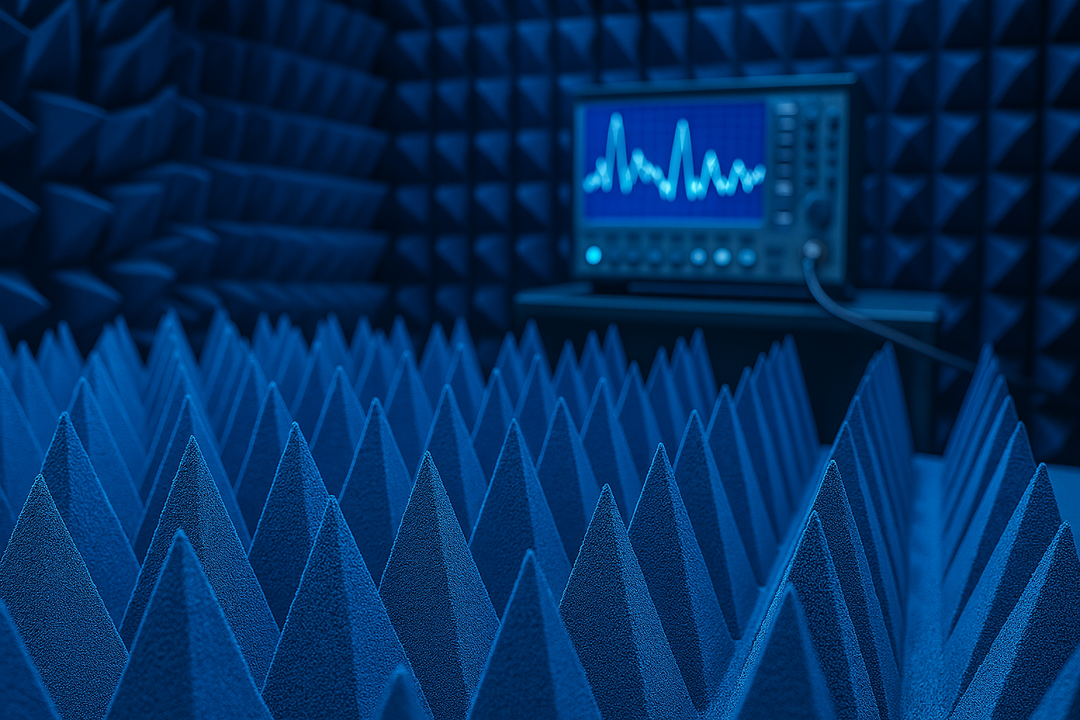
Indoor anechoic chambers are the dominant application for commercial radar absorbing material. A controlled environment protects polyurethane foam from the moisture, UV, and thermal cycling that degrade carbon loading over time. Chambers at –50 dB reflectivity or better give engineers the signal isolation needed for near-field antenna scans, radar cross-section measurements, and over-the-air device testing.
Outdoor ranges introduce variables no absorber material fully controls – rain, humidity, aircraft interference, and commercial radio signals. For repeatable, schedule-reliable testing, the indoor chamber is the better option on every metric: performance, security, and year-round availability.
Field test setups are the exception. When a permanent chamber isn't practical, elastomeric RAM panels offer weather resistance that foam cannot match, with the accepted trade-off of lower reflectivity performance.
dB Absorber Pyramidal Absorbers
dB Absorber supplies NRL 8000-certified pyramidal anechoic absorbers in seven standard sizes from 2-inch to 36-inch, covering 100 MHz to 110 GHz. All products are carbon-loaded polyurethane foam with independent fire safety test data on file, and they ship from California within one to two business days—no six-week waits.
Whether the project is a new EMC chamber, a radar cross-section facility, or targeted EMI control inside an enclosure, the right absorber specification starts with verified data. Browse the full absorber catalog at dB Absorber and get the performance documentation needed before placing an order.
FAQ: Radar Absorbing Material
What is the difference between RAM and radiation absorbent material?
They refer to the same thing. RAM is the abbreviation for radiation absorbent material – a broad category of engineered materials designed to reduce reflected RF energy across a target frequency range.
Why does pyramid size affect frequency performance?
The height of a pyramid determines the lowest frequency at which progressive impedance matching works effectively. Longer wavelengths require taller pyramids – a 2-inch pyramid works well above 10 GHz, while a 36-inch pyramid extends absorption down toward 100 MHz.
Is NRL 8000 certification mandatory?
Not universally, but it's required for the U.S. government, defense, and most military installations. Commercial builds may only need ASTM E84 Class A. Checking the project specification before ordering prevents rework.
How long do pyramidal foam absorbers last?
In a stable indoor environment, well-manufactured carbon-loaded foam holds its electromagnetic properties for many years – often a decade or more. Degradation accelerates with UV exposure, moisture, and physical damage, which is why outdoor use without enclosure is not recommended.
Can different absorber types be used in the same chamber?
Yes – hybrid chambers do exactly this. Ferrite tiles at the base layer handle low frequencies; pyramidal foam handles everything above 1 GHz. This combination is standard practice in full-spectrum anechoic facilities.