GTEM Cell vs Anechoic Chamber: Pre-Compliance Setup Guide

GTEM Cell vs. Anechoic Chamber for Pre-Compliance Testing
Wireless spectrum is getting crowded fast – according to the ITU's Facts and Figures 2025 report, 5G networks now cover 55% of the world's population and account for roughly one-third of all mobile broadband subscriptions worldwide. Every one of those connected products had to pass some form of electromagnetic compatibility testing before it reached a shelf. That reality puts one practical question in front of nearly every hardware team: GTEM cell vs anechoic chamber – which setup actually fits the product being built?
There isn't a single right answer. The decision hinges on device size, budget, and how close the in-house results need to match what an accredited lab will eventually report.
What Is Pre-Compliance Testing, and Why Bother With It?
Pre-compliance testing is an internal check run before a product goes to a certified test house. It catches emissions and immunity problems early, when fixing them is still cheap.
Skipping this step doesn't make the risk disappear – it just moves the discovery point later, usually to a moment that costs more time and money. Choosing between a GTEM cell and an anechoic chamber for this purpose comes down to how the two structures handle electromagnetic fields.
GTEM Cell: The Compact Option
A GTEM cell is a tapered coaxial waveguide with a metal septum plate inside that works as both structure and receiving antenna. No external antenna setup is required, which keeps testing fast.
These units range from small desktop models to roughly two meters tall, so most labs can fit one without construction work. That's the main appeal in the GTEM cell vs anechoic chamber comparison: speed and portability.

Anechoic Chamber: The Full-Scale Reference
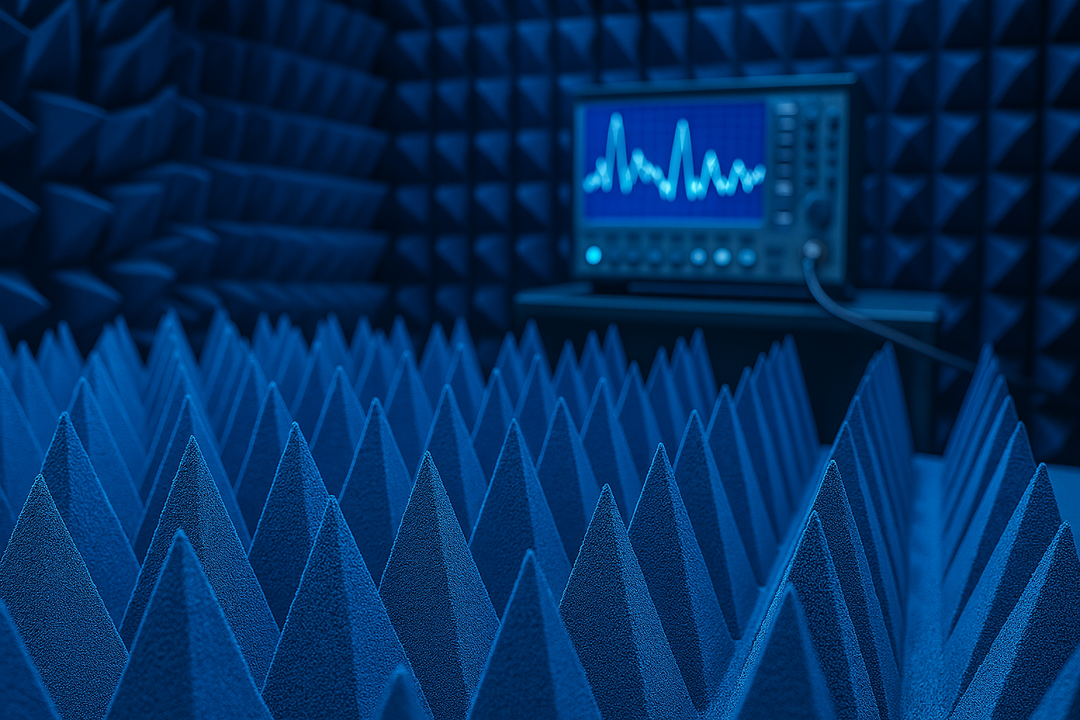
An anechoic chamber is a dedicated room lined with RF-absorbent material, built to eliminate reflections and mimic open-space conditions. Antennas and turntables sit inside the room itself, giving direct control over distance, angle, and polarization.
Because this setup mirrors Open Area Test Sites, chamber results correlate closely with official compliance testing – without needing complex mathematical conversion. That correlation is the biggest reason many engineering teams pick a chamber over a GTEM cell for later-stage validation.

Comparing the Two Side by Side
| Feature | GTEM Cell | Anechoic Chamber |
|---|---|---|
| Space needed | Bench or floor unit | Dedicated room |
| Device size limit | Small components, handheld units | Large systems, vehicles, appliances |
| Setup cost | Lower, R\&D-friendly | Higher capital investment |
| Antenna setup | Not required (septum acts as antenna) | Required, with calibrated positioning |
| Correlation to compliance | Uses mathematical correlation | Direct real-world correlation |
Neither column is "better" in the abstract. A GTEM cell wins on convenience; a chamber wins on accuracy at scale.
GTEM Cell vs Anechoic Chamber: Matching the Setup to the Product
A few honest questions usually settle the GTEM cell vs anechoic chamber debate faster than any spec sheet:
- What's the largest product likely to need testing over the next few years?
- Is the priority quick, repeatable screening, or a close match to third-party lab conditions?
- Is there room – physically and financially – for a permanent chamber?
Small electronics, sensors, and handheld devices tend to favor a GTEM cell. Larger systems – EV components, industrial equipment, defense hardware – generally outgrow what a GTEM cell can accommodate, which pushes the decision toward a chamber.
A Note on Frequency Range
Not every setup covers the full range a standard demands. GTEM cells are governed by IEC/EN 61000-4-20 for radiated emissions and immunity, and chamber absorber materials often need to perform anywhere from 9 kHz up through 40 GHz. Checking the manufacturer's specified frequency range against the applicable standard before purchase avoids a costly gap later.
Why Electrical Equipment Failures Are Getting More Scrutiny
Regulators aren't easing up on electronics. The European Commission's 2025 Safety Gate report recorded 4,671 product safety alerts across the EU and EEA – the highest number since the system launched in 2003 – with follow-up enforcement actions up 35% year over year.
Electrical appliances and equipment were among the most frequently reported categories. That trend doesn't leave much room for guesswork in pre-compliance testing, whether the method chosen is a GTEM cell or a full chamber build.
What Actually Makes a Chamber Work: The Absorber Question
Choosing an anechoic chamber is only half the job. The material lining its walls determines whether the readings inside it can be trusted.
Why Pyramidal Foam Absorbers Are the Standard
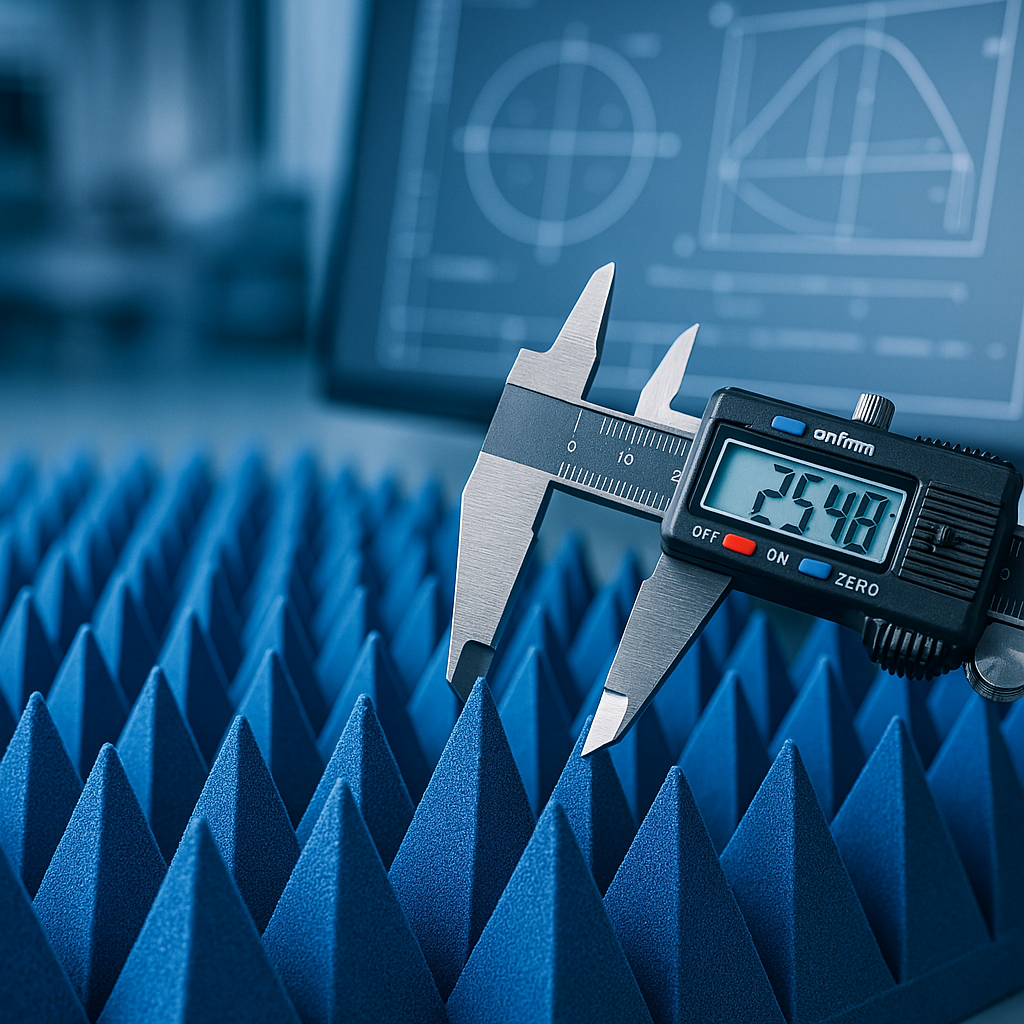
Pyramidal absorbers gradually taper electromagnetic energy into the foam, reducing reflections across a wide frequency band instead of just a narrow slice. This geometry has been the industry default for decades because it consistently outperforms flatter or less-engineered shapes.
Quality still varies a lot between suppliers. A few things worth checking before committing to a batch:
- Fire rating – foam that meets recognized flammability standards, not just a manufacturer's claim.
- Attenuation data – documented performance across the actual frequency range being tested, not a generic datasheet.
- Longevity – foam that holds its shape and performance for years rather than degrading after repeated use.
Pro tip: absorbers that look identical on a spec sheet can behave very differently once installed – asking for third-party test data before purchase is worth the extra step.
Building a Chamber That Delivers Trustworthy Results
A well-lined chamber, fitted with correctly specified pyramidal foam absorbers, gives engineers a room they can rely on – not just one that resembles a proper test environment. That distinction matters most for teams making design decisions based on in-house data before a product ever reaches a certification lab.
db Absorber supplies pyramidal RF absorbers built for consistent attenuation, durable fire-rated foam, and documented performance across a wide frequency span. Whether the project involves constructing a new chamber or replacing aging panels in an existing one, reaching out for absorber specifications suited to the exact frequency range and budget in question is a practical next step toward test results worth trusting.
Frequently Asked Questions
Is a GTEM cell as accurate as an anechoic chamber?
Not quite, though it isn't meant to be. A GTEM cell relies on mathematical correlation algorithms to approximate open-area results, while a chamber recreates those conditions directly. For pre-compliance screening, a GTEM cell's accuracy is usually more than sufficient; for final validation, a chamber gives a closer match to what a certification body will report.
Can a GTEM cell replace full compliance testing?
No. GTEM cells are designed specifically for pre-compliance work, catching obvious issues early in development. Final certification still needs to happen at an accredited third-party lab, regardless of which in-house method was used beforehand.
What size limitations does a GTEM cell have?
GTEM cells range from desktop units to roughly two meters tall, which limits them to small and medium-sized equipment under test. Larger products – appliances, vehicle components, industrial systems – generally require the open floor space of an anechoic chamber instead.
How often do pyramidal foam absorbers need to be replaced?
It depends on the quality of the material and how heavily the chamber is used, but well-built, fire-rated pyramidal absorbers can maintain performance for many years. Absorbers that degrade, lose shape, or fall short of their rated attenuation should be flagged for replacement before they compromise test accuracy.
Does a GTEM cell need external antennas?
No. The internal septum plate functions as both the chamber's core structure and its receiving antenna, which is part of why GTEM cells set up faster than chambers. This also removes the need for antenna alignment procedures during testing.
What frequency range should a chamber's absorbers cover?
Requirements vary by standard, but many compliance tests call for coverage from around 9 kHz up through 40 GHz. Confirming the documented frequency range of any absorber material against the applicable standard before purchase prevents gaps in coverage later on.