The Rise of Bio-Based RF Absorber Foam: Sustainable Alternatives

The Rise of Sustainable Shielding: Can Bio-Based Polymers Replace Polyurethane in RF Absorbers?
Petroleum-based polyurethane has been the default material in electromagnetic shielding for decades. It performs well, scales easily in manufacturing, and costs relatively little. But the environmental toll has become harder to ignore — and now researchers are asking whether bio-based alternatives can take their place in RF absorber foam without losing the technical properties that matter.
The honest answer is: in specific applications, yes. Across the board, not quite yet.
What Makes RF Absorber Foam So Hard to Replace
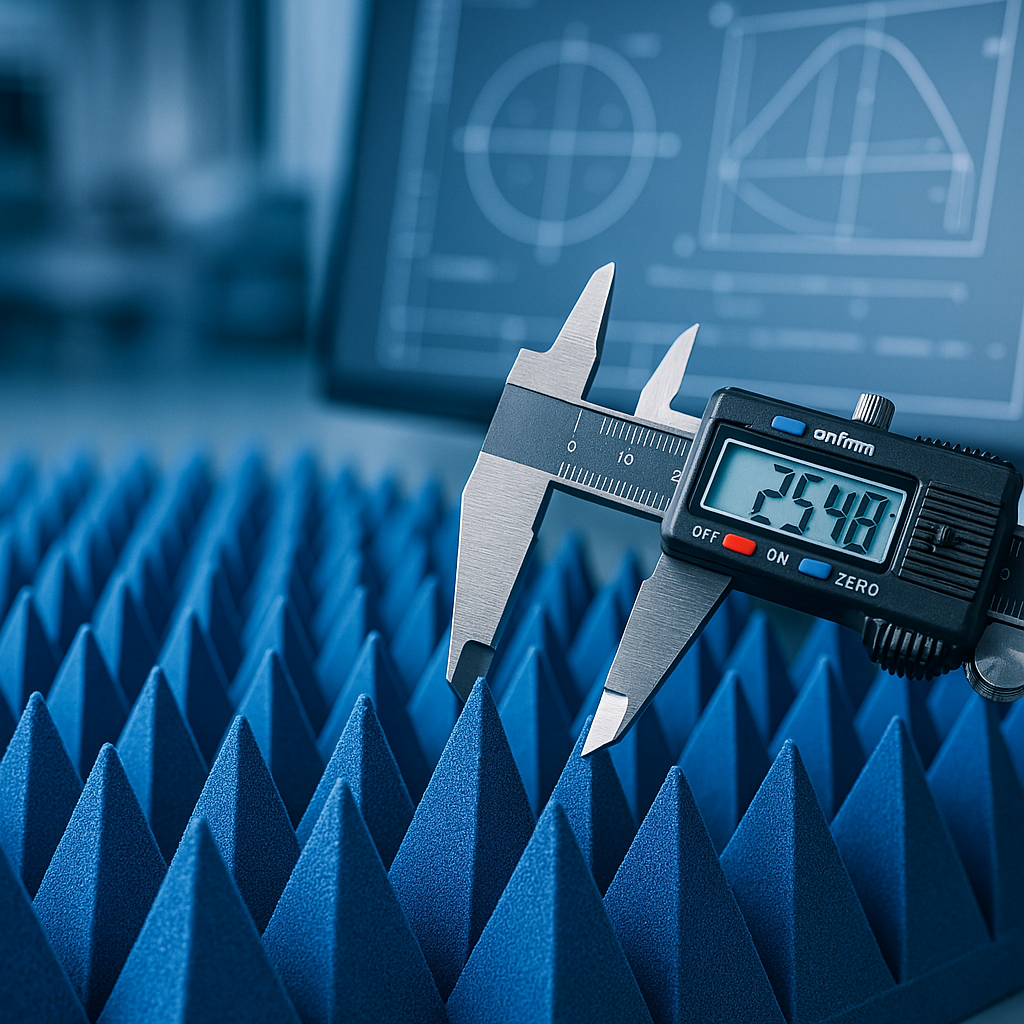
RF absorber foam works by converting electromagnetic wave energy into heat through resistive losses. Most commercial products use open-cell polyurethane loaded with carbon black or graphite fillers — a combination that delivers broadband attenuation, low weight, and the flexibility to fit complex geometries in anechoic chambers, radar systems, and electronic enclosures.
None of that is going away. The material performs, and that's not the problem.
The problem is what happens before and after. Standard polyurethane is synthesized from isocyanates and polyols derived from fossil fuels. Global PU foam production exceeds 4 million tons annually, and the waste management side is bleak. In the United States alone, industrial and postconsumer polyurethane waste is managed with landfilling, incineration, and recycling at shares of 58%, 12%, and 30%, respectively — meaning well over half ends up buried. PU waste accumulation in landfills can intensify soil and groundwater pollution due to the material's low biodegradability.
There's also a regulatory push. The EU's Ecodesign Regulation and tightening ESG procurement standards are forcing manufacturers across electronics, aerospace, and defense to reassess the full lifecycle of their materials — including RF absorbing foam.
Bio-Based Foams: What the Research Actually Shows
Bio-based polyurethane foams (BPUFs) are not new — but their viability in technically demanding RF applications is a more recent development.
Researchers have produced promising RF foam absorber candidates from castor oil, Sapium sebiferum kernel oil, and other vegetable-oil-derived polyols. These plant-based precursors replace conventional petroleum polyols while preserving the foam's core structure: open-cell porosity, low density, and physical flexibility. When combined with magnetic nanoparticles or carbon-based conductive fillers, bio-derived foams demonstrate genuine microwave absorption capability at frequencies relevant to commercial RF shielding.
That said, a recurring limitation in the literature is bandwidth. Bio-based RF absorber foam tends to perform well within narrow frequency windows, while conventional engineered foam covers much wider GHz ranges. For applications that only require narrowband performance, this isn't disqualifying. For broadband use cases like large anechoic test chambers, it's a real constraint.

Three Key Properties Bio-Based Foams Retain
Before writing off the performance gap, here's what bio-derived formulations do carry over from traditional foam:
- Open-cell porosity that allows electromagnetic wave penetration and internal scattering
- Low bulk density, which is critical for weight-sensitive aerospace and electronic applications
- Mechanical flexibility to conform around irregular surfaces and enclosures
These aren't minor properties. They are the structural foundation of any effective RF absorber foam — and bio-based variants preserve them.
Turning Waste Into a Shielding Material
Not all sustainable shielding research focuses on polyurethane at all. A peer-reviewed study published in ScienceDirect took a different path entirely: researchers reinforced a bio-based epoxy with three recycled fillers — recycled aluminum foil, red mud, and recycled rigid polyurethane powder — achieving a shielding effectiveness of -35.12 dB in the X-band (8–12 GHz). That sits above the -20 to -30 dB range most commercial shielding systems target for the same frequency band.
Red mud, an iron-rich byproduct of aluminum production, is one of the most abundant industrial waste streams on the planet. Recycled aluminum foil contributes high electrical conductivity. Together in a bio-epoxy matrix, these composites support circular economy principles while enhancing performance across acoustic and electromagnetic applications.
The environmental logic compounds: waste-derived inputs, a bio-based binder, and competitive shielding numbers. That's a meaningful shift from the conventional RF absorbing foam supply chain.
Agricultural Waste as a Functional Filler
One less obvious direction involves agricultural residue. Rice husks, sugarcane bagasse, and banana leaves have been tested as fillers in polymer matrices for RF applications. At concentrations of roughly 10–40%, these materials can influence the dielectric constant of the composite — which directly affects electromagnetic wave interaction. They won't replace precision-engineered carbon fillers, but in lower-frequency and cost-sensitive applications, they offer a sustainability profile worth considering.
Performance vs. Conventional RF Foam Absorber Products
Bio-based composites have closed the gap in targeted frequency ranges. For X-band applications specifically, lab results are competitive. Broadband performance remains a harder problem — pyramid-shaped RF absorber foam products optimized over decades of geometric and material refinement aren't easily matched by formulations still early in development.
Mechanical durability data is also thinner. Petroleum-based polyurethane has well-documented long-term performance under thermal cycling, humidity, and compression loading. Bio-based equivalents simply haven't accumulated that testing history yet.
The Non-Isocyanate Route Worth Watching
Non-isocyanate polyurethane (NIPU) synthesized from renewable resources eliminates the toxic isocyanate chemistry from the equation entirely. More importantly, it functions as a drop-in replacement — processable on existing manufacturing lines without requiring new equipment. In an industry where capital investment is the primary adoption barrier for new materials, that matters considerably.
The remaining challenges for bio-based RF absorber foam aren't insurmountable. Several active research programs are specifically targeting bandwidth optimization and long-term durability testing. The trajectory is clear: bio-based shielding is moving from promising anomaly to credible alternative.
Polyurethane's dominance in RF absorber foam isn't ending tomorrow. But the materials that challenge it are already in the lab — and some of them are already competitive.