Where Sound Meets Its Match: The Role of Anechoic Absorbers in Testing
Sound has a funny way of bouncing around. Drop a pin in an empty room and you'll hear it echo off every surface. Now imagine trying to test a microphone, a speaker system, or even a car's interior noise levels in that same room. The reflections would completely mess up your measurements. You'd be testing the room as much as the product itself.
That's where anechoic absorbers come into play. These specialized materials create spaces where sound goes in but doesn't come back out. For engineers testing everything from smartphones to aircraft engines, having a controlled acoustic environment isn't just helpful—it's absolutely necessary. Without the ability to eliminate unwanted sound reflections, precise measurements become nearly impossible. The data gets contaminated by echoes, reverberations, and interference that have nothing to do with the device being tested.
Industries from telecommunications to automotive manufacturing depend on accurate acoustic testing. When a company designs a new hearing aid, they need to know exactly how it performs without environmental noise skewing the results. When aerospace engineers test jet engine noise, they can't have sound bouncing off walls and creating false readings. The anechoic absorber solves this problem by creating what's essentially a sonic black hole—a space where sound energy gets absorbed rather than reflected.
The Science Behind Anechoic Absorbers
What is an Anechoic Absorber?
An anechoic absorber is a specially designed material that captures sound waves and converts their energy into heat. The term "anechoic" literally means "without echo," which perfectly describes what these materials accomplish. Unlike regular acoustic foam you might stick on a bedroom wall, anechoic absorbers are engineered to eliminate reflections across specific frequency ranges with exceptional efficiency.
These absorbers work through a combination of geometry and material properties. When a sound wave hits an anechoic absorber, it enters a structure designed to trap it. The wave travels into the material's cavities, losing energy with each interaction until virtually nothing bounces back.
How Anechoic Absorbers Work
The magic happens through repeated interaction with the absorber's surface and internal structure. Sound waves entering the material bounce around inside the absorber's geometry—whether that's a pyramid shape, wedge pattern, or foam structure. Each time the wave interacts with the material, some of its energy converts to heat through friction and molecular movement. By the time the wave might exit, it's been reduced to negligible levels.
The effectiveness of an anechoic chamber absorber depends on several factors: the material's porosity, the depth of the absorber, and the geometry of its surface. Deeper absorbers generally perform better at low frequencies, while surface geometry helps tackle higher frequencies.
Why Sound Reflection Must Be Minimized
In testing environments, reflections create what engineers call "standing waves" and "room modes." These are patterns where reflected sound combines with direct sound, creating peaks and nulls at different frequencies. One spot in the room might measure 10 decibels louder than another spot just a foot away—not because the device is performing differently, but because of how sound waves interact with the space.
For accurate testing, you need what's called a "free field" condition—where sound radiates outward without interference. Only by minimizing reflections can testers isolate the true performance characteristics of the device under test.
Different Types of Anechoic Absorbers
Absorbers in Anechoic Chambers
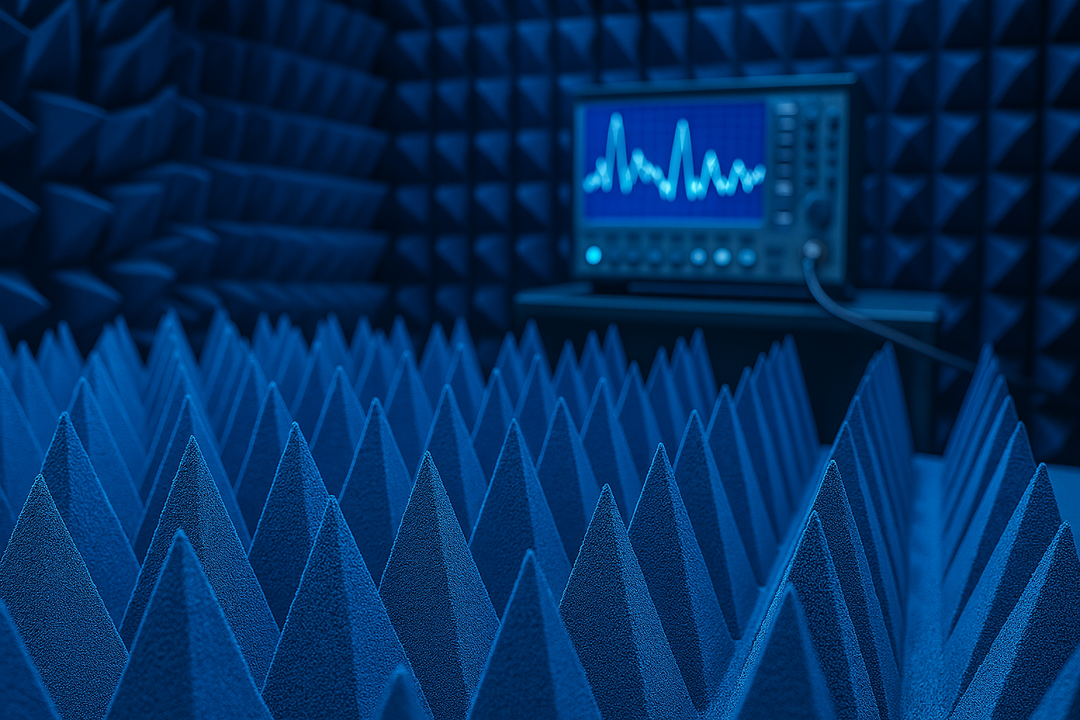
Full anechoic chambers line their walls, ceiling, and floor with absorbers to create a completely reflection-free environment. Semi-anechoic chambers typically have absorbers on walls and ceiling, but leave the floor reflective for easier equipment placement. The absorbers in these chambers must work together to handle sound coming from any direction.
Materials Used in Anechoic Absorbers
The most common materials include:
- Open-cell polyurethane foam: Lightweight and effective for a broad frequency range, this material allows sound waves to penetrate deeply while its cellular structure dissipates energy
- Fiberglass: Often used in combination with other materials, fiberglass offers excellent absorption properties and can handle higher temperatures than foam
- Melamine foam: Known for its fire-resistant properties and consistent performance across frequencies, making it ideal for safety-conscious applications
Each material brings different advantages. Foam excels at mid and high frequencies, while fiberglass can be engineered for better low-frequency performance.
Design Variations: Pyramidal, Wedge, and Foam Absorbers
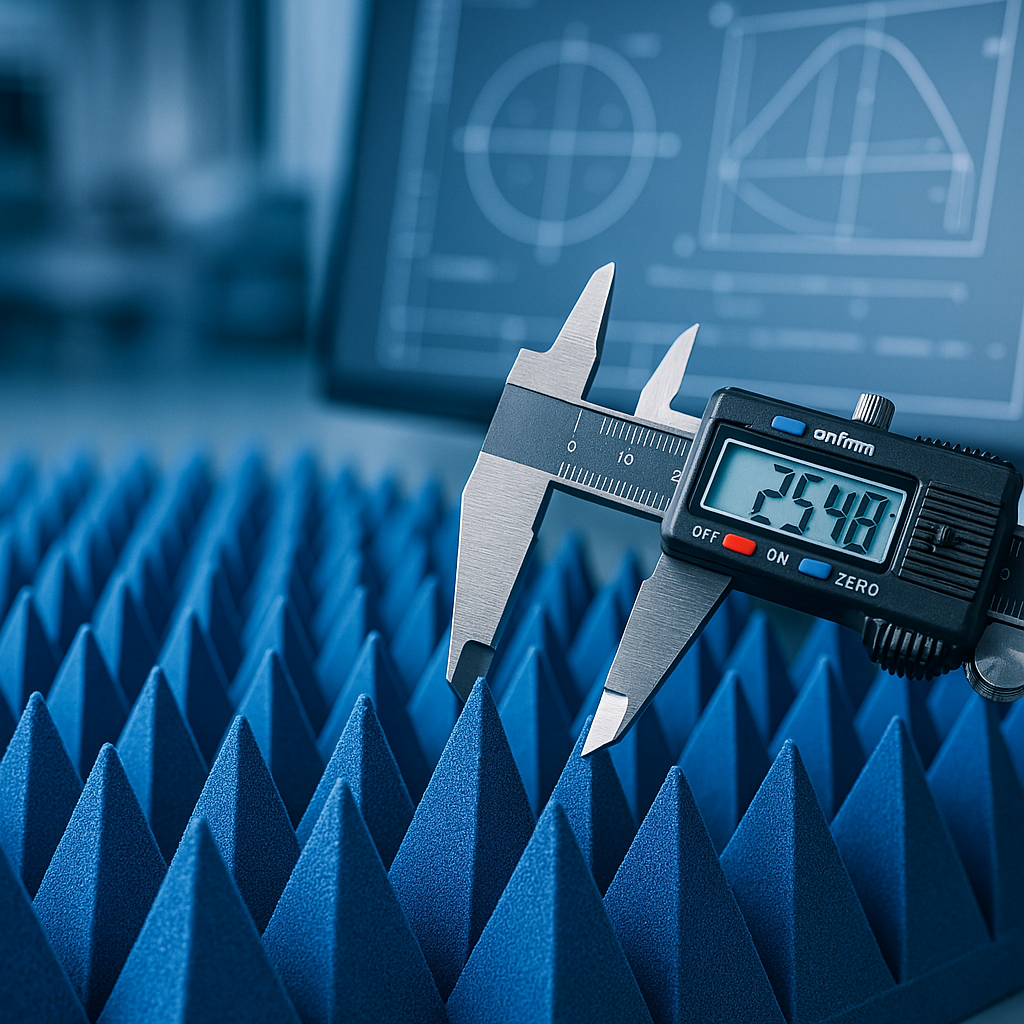
Pyramidal absorbers are perhaps the most recognizable design. Their pointed shapes create a gradual transition between air and absorptive material, reducing reflections across a wide frequency range. The graduated geometry means sound waves encounter progressively more material as they penetrate deeper.
Wedge absorbers offer similar benefits but with a different geometric approach. They're sometimes preferred when space constraints limit the depth available for pyramids. Flat foam absorbers work for less demanding applications where some reflection is acceptable or where only specific frequency ranges need attention.
The Role of Anechoic Absorbers in Different Testing Environments
Anechoic Chambers for Acoustic Testing
Pure acoustic testing demands the most rigorous control. When testing microphones, speakers, or audio equipment, even minor reflections can throw off measurements. Anechoic absorbers in these chambers typically extend deep into the room—sometimes two meters or more—to capture low-frequency sound that would otherwise reflect.
Audio engineers use these chambers to measure speaker response curves, test microphone sensitivity patterns, and develop noise-canceling technology. The absorbers ensure that what they're measuring is the device's actual performance rather than room effects.
Anechoic Absorbers in RF and EMC Testing
Radio frequency and electromagnetic compatibility testing requires a different kind of anechoic environment. Here, absorbers need to handle electromagnetic waves rather than sound waves. These specialized absorbers contain materials like carbon-loaded foam or ferrite tiles that absorb radio waves. The principles remain similar—eliminate reflections to get accurate measurements—but the physics differs significantly.
Impact on Automotive and Aerospace Testing
Car manufacturers test vehicle interiors in semi-anechoic chambers to measure cabin noise, speaker system performance, and how well sound insulation works. The anechoic chamber absorber materials help isolate specific noise sources—is that rattle coming from the dashboard or the door panel? Without absorption, reflected sound makes pinpointing sources extremely difficult.
Aerospace applications take this further. Testing aircraft components, engine noise, and cabin acoustics requires massive chambers with correspondingly large absorber installations. The stakes are high—passenger comfort and regulatory compliance depend on accurate noise measurements.
Applications in Consumer Electronics Testing
Your smartphone went through anechoic testing before reaching your pocket. Manufacturers test microphone arrays, speaker quality, and how well voice assistants can hear you. Wireless earbuds get tested for audio quality and noise cancellation performance. Smart speakers need verification that their far-field microphones can hear commands from across the room. Every test relies on anechoic absorbers to create a controlled environment.
Challenges and Limitations of Anechoic Absorbers
Space Limitations
Effective absorption requires depth. Low-frequency absorption is particularly demanding—absorbing a 50 Hz wave effectively might require absorbers several meters deep. Not every facility can dedicate that much space to a testing chamber. Companies must balance performance requirements against available real estate and construction costs.
Cost Considerations
Building an anechoic chamber isn't cheap. The specialized materials, construction requirements, and testing needed to verify performance add up quickly. Small and medium-sized companies often struggle to justify the expense, instead outsourcing testing to shared facilities or accepting less-than-ideal testing conditions.
Material and Environmental Challenges
Anechoic absorbers face several practical issues:
- Durability concerns: Foam materials degrade over time, especially with UV exposure, temperature fluctuations, and physical contact
- Fire safety requirements: Many facilities require fire-rated materials, limiting options and increasing costs
- Cleaning and maintenance: Dust and debris accumulate on absorber surfaces, potentially affecting performance, yet cleaning can damage the delicate structures
Limitations in Low-Frequency Absorption
Physics places hard limits on absorption. The general rule states that absorbers need to be at least one-quarter the wavelength of the sound they're absorbing. For a 50 Hz tone with a wavelength of about 7 meters, that means absorbers would need to be nearly 2 meters deep for effective absorption. Many facilities simply can't accommodate this, accepting reduced performance at the lowest frequencies.
The Path Forward for Acoustic Testing
Anechoic absorbers remain fundamental to accurate acoustic testing across industries. They transform ordinary rooms into precisely controlled environments where sound behaves predictably. Whether testing a tiny hearing aid or a massive jet engine, the principle stays the same—eliminate reflections to measure what truly matters.
The technology continues to advance. New materials offer better performance in smaller packages. Hybrid designs combine different absorber types to optimize cost and effectiveness. As products become more sophisticated and standards more stringent, the role of anechoic absorbers only grows in importance.
For anyone involved in acoustic testing, understanding how anechoic absorbers work provides insight into why proper test facilities matter. The next time you use a device with clear audio or ride in a quiet car, remember that anechoic absorbers played a role in making that experience possible. They're the unsung heroes behind the products we use daily—the places where sound meets its match.
Looking for high-quality RF absorbers? Browse our in-stock pyramidal absorbers — shipping from California in 1-2 business days.