Anechoic Chamber Calibration: Long-Term Accuracy

Even a small gap in absorber coverage can throw off a chamber's readings enough to invalidate a test. Research on anechoic chamber calibration – including peer-reviewed work available through ResearchGate and shielding-effectiveness studies published by the University of Twente – consistently shows that minor reflections, not major structural flaws, are usually what pull test data off spec. That's the uncomfortable part of running a chamber: the failures are rarely dramatic. They're quiet, gradual, and easy to miss until a test report gets challenged.
What Does Calibration Actually Protect?
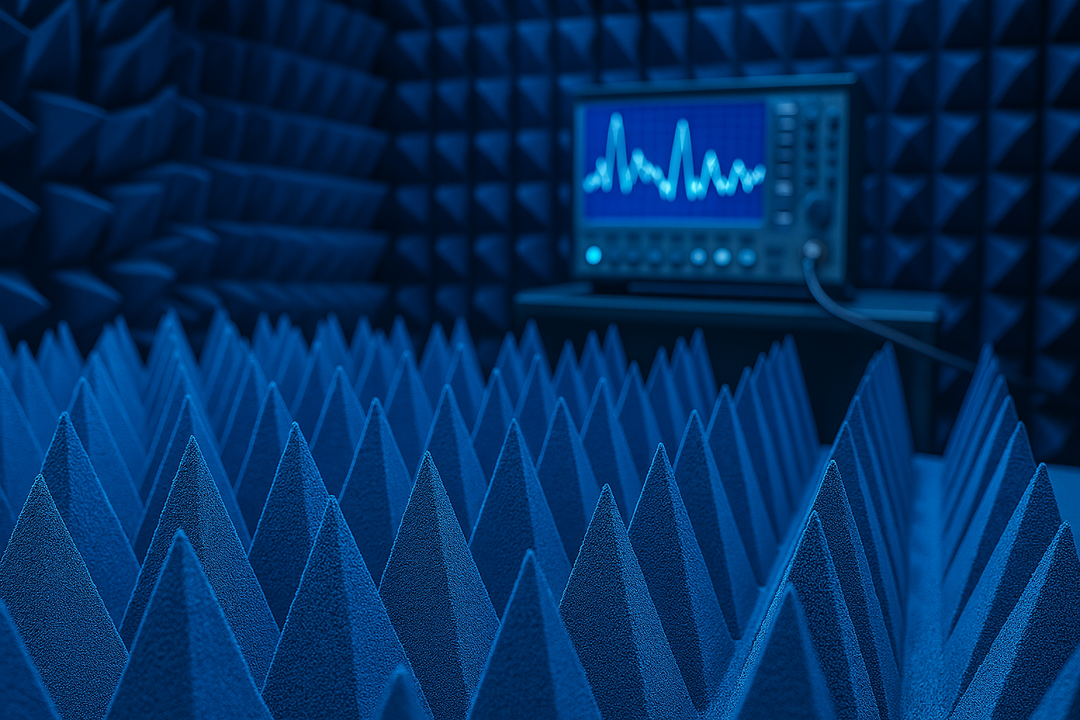
It protects the illusion of infinite free space. That's the whole point of an anechoic chamber is to simulate open-field conditions inside a closed room. And anechoic chamber calibration is what confirms that illusion still holds.
Without it, a lab has no way of knowing whether a shift in test results comes from the product being tested or from the chamber itself quietly drifting out of spec.
Why "Passed Once" Doesn't Mean "Still Passing"
A chamber validated five years ago isn't automatically valid today. Foam compresses. Shielding shifts by fractions of a millimeter. Humidity works its way into materials that started out completely dry.
None of this shows up on a walkthrough. It shows up in the data.
The Four Pillars of a Working Calibration Routine
Reliable chambers aren't maintained through instinct – they follow a repeatable structure. Below is a quick breakdown of what that structure typically includes.
| Calibration Stage | What It Checks | Why It Matters |
|---|---|---|
| Baseline Qualification | Compliance with ISO 3745, ISO 26101, IEC/ANSI benchmarks | Gives every future test a fixed point of comparison |
| Quiet Zone Mapping | Signal uniformity across the test volume | Catches structural drift before it skews results |
| Absorber Inspection | Physical and chemical condition of RF/acoustic foam | Prevents reflectivity increases from corrupting readings |
| Equipment Traceability | Drift in analyzers, probes, and cabling | Confirms the measuring tools are as accurate as the chamber |
Setting a Real Baseline
A baseline is only useful if it's documented, not assumed. Acoustic rooms are generally checked against ISO 3745 and ISO 26101 to confirm genuine free-field behavior, while electromagnetic chambers follow IEC and ANSI benchmarks for absorption and frequency range.
Note: labs that skip this step often discover the gap during an audit – when a client asks for historical calibration records that simply don't exist.
How Is the Quiet Zone Actually Measured?
It's measured point by point, not estimated. The Quiet Zone (QZ) is the working core of the chamber, and mapping it means moving a calibrated, omnidirectional probe through a grid of coordinates while logging signal strength at each one.
Those readings are then checked against the inverse-square law, and any deviation gets flagged by frequency – because a chamber can behave perfectly at one band and poorly at another.
Pro Tip: Testing a single frequency and assuming the rest of the band behaves the same way is one of the more common (and costly) shortcuts labs take.
Absorber Wear: The Problem Hiding in Plain Sight
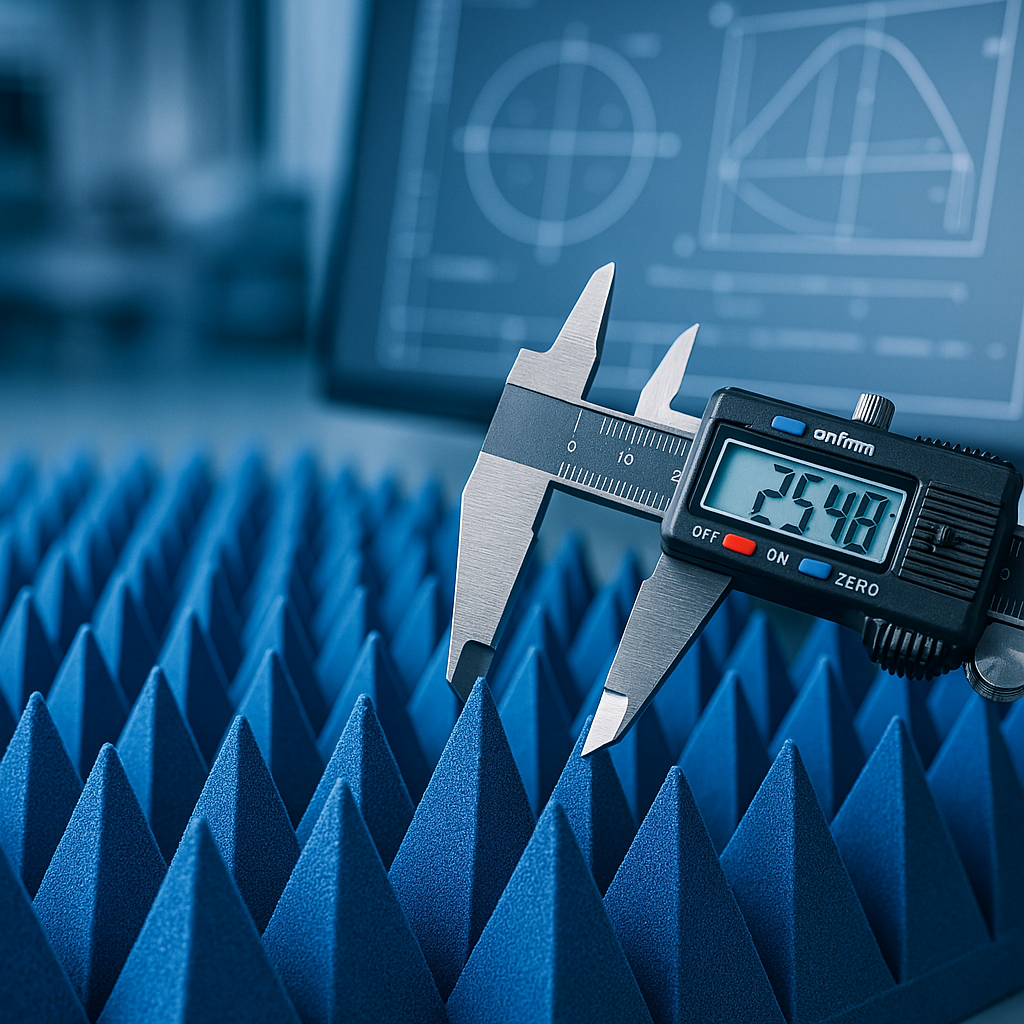
Absorbers rarely fail all at once – they degrade quietly, which is exactly why they're so often overlooked between formal inspections. Anechoic chamber panels, especially carbon-loaded pyramidal foam, are engineered for a specific absorption performance, and that performance depends entirely on the material staying physically intact.
A few conditions accelerate that breakdown faster than most people expect:
- High RF power exposure, which can char or compress foam over repeated testing cycles
- Humidity, which weakens polyurethane structure from the inside out
- Physical impact, from equipment carts, cables, or careless handling during setup
What Damaged Absorbers Actually Do to a Test
They reflect energy the chamber was designed to absorb. That's the short version. A torn tip or a loosened panel doesn't just look bad – it introduces reflections that the original chamber specifications never accounted for, which means every calibration cycle after that point is measuring against a chamber that no longer matches its own documentation.
Equipment Drift: The Part Nobody Blames First
Instruments drift too, and it's rarely the first thing anyone suspects when results look off. Network analyzers, reference antennas, and microphones all need periodic calibration against traceable standards, since even small deviations compound over time.

Cabling and connectors matter just as much. Because every signal path performs a little differently, each measurement channel typically needs its own calibration rather than a single blanket adjustment across the whole system.

Where DB Absorber Fits Into This
None of the above matters much if the absorbers lining the chamber were never built to hold their specifications in the first place. That's the gap DB Absorber exists to close – supplying pyramidal RF absorbers engineered for consistent density, stable carbon loading, and resistance to the humidity and minor impact that wear down lower-grade foam over time.
Facilities dealing with any of the following tend to benefit most from an absorber upgrade:
- Quiet Zone readings that drift more than expected between calibration cycles
- Visible tearing, sagging, or discoloration on existing pyramidal panels
- Compliance testing that's started producing inconsistent or borderline results
Replacing worn panels isn't just a repair – it's an input into how easy every future calibration cycle will be.
DB Absorber supplies pyramidal RF absorbers built to maintain their performance over years of real-world testing conditions – reach out to discuss which specifications fit your chamber's frequency range and current Quiet Zone data.
Frequently Asked Questions
How often should a chamber go through full calibration?
Most facilities schedule full requalification annually, though high-usage chambers or those supporting compliance testing often benefit from more frequent quiet zone checks.
Can absorber panels be repaired instead of replaced?
Minor surface damage sometimes tolerates spot repair, but tearing, compression, or humidity-related crumbling typically requires replacement to restore accurate absorption.
Does chamber size affect calibration frequency?
Larger chambers generally have more surface area exposed to wear, which can mean more frequent absorber inspections even if the overall calibration schedule stays the same.
What's the fastest way to tell if absorbers are degrading?
A gradual increase in Quiet Zone deviation across calibration cycles is usually the earliest measurable sign, often before any visible damage appears.