RF Absorber Power Handling & Safety: Complete Rating Guide

Understanding Absorber Power Handling Ratings & Safety
What actually happens when an RF absorber gets pushed past its limit? It heats up, and if that heat has nowhere to go, the foam scorches, deforms, or stops performing altogether. Demand for accurate EMC testing keeps climbing as more products need radiated immunity certification – the UL 94 flammability standard itself was revised as recently as July 2026, adding new flame-stabilization requirements that affect how foam-based materials get classified for chamber use.
That single fact says a lot about the industry right now: safety and power handling standards for absorber materials aren't static. They get reviewed, tightened, and occasionally rewritten. For labs choosing pyramidal foam absorbers, staying current with these ratings isn't optional – it's what keeps a chamber both accurate and safe to operate.
Test engineers rarely think about power handling until a chamber gets asked to run a program it wasn't originally built for. Higher-output amplifiers, tighter automotive immunity requirements, and denser test schedules all put more continuous energy into absorber material than older facilities were designed to tolerate.
What Is RF Absorber Power Handling?
RF absorber power handling is the maximum continuous wave (CW) energy a piece of absorber material can safely convert into heat without permanent damage. It's usually expressed in W/in² (or the metric equivalent, kW/m²), and it's tied directly to how well a material sheds heat versus how fast energy is pouring in.

Why the Number on the Spec Sheet Matters More Than It Looks
A rating isn't just a technical detail buried in a datasheet. Exceed it, and three things tend to happen, in this order:
- The absorptive coating starts to degrade, which quietly worsens reflectivity performance before anyone notices
- The foam itself can discolor, warp, or become brittle at the tips
- In extreme cases, especially with poor ventilation, localized overheating becomes a fire risk
None of these show up instantly. That's part of what makes power handling easy to overlook – the damage is gradual, not dramatic.
Reading W/in² and kW/m² Ratings Correctly
So what does a number like 0.5 W/in² actually correspond to in a working chamber? Roughly 540 V/m of far-field E-field strength under continuous wave illumination – a figure many EMC engineers recognize immediately from common radiated immunity test levels.
How the Main Absorber Types Compare
Here's where the differences between absorber categories become easier to see side by side:
| Absorber Type | Typical CW Rating (No Forced Air) | Max Continuous Temperature |
|---|---|---|
| Standard polyurethane foam | 0.5 W/in² | \~90°C |
| Filtered (porous) foam | 1 W/in² | \~90°C |
| Honeycomb phenolic | 2 W/in² | up to 250°C |
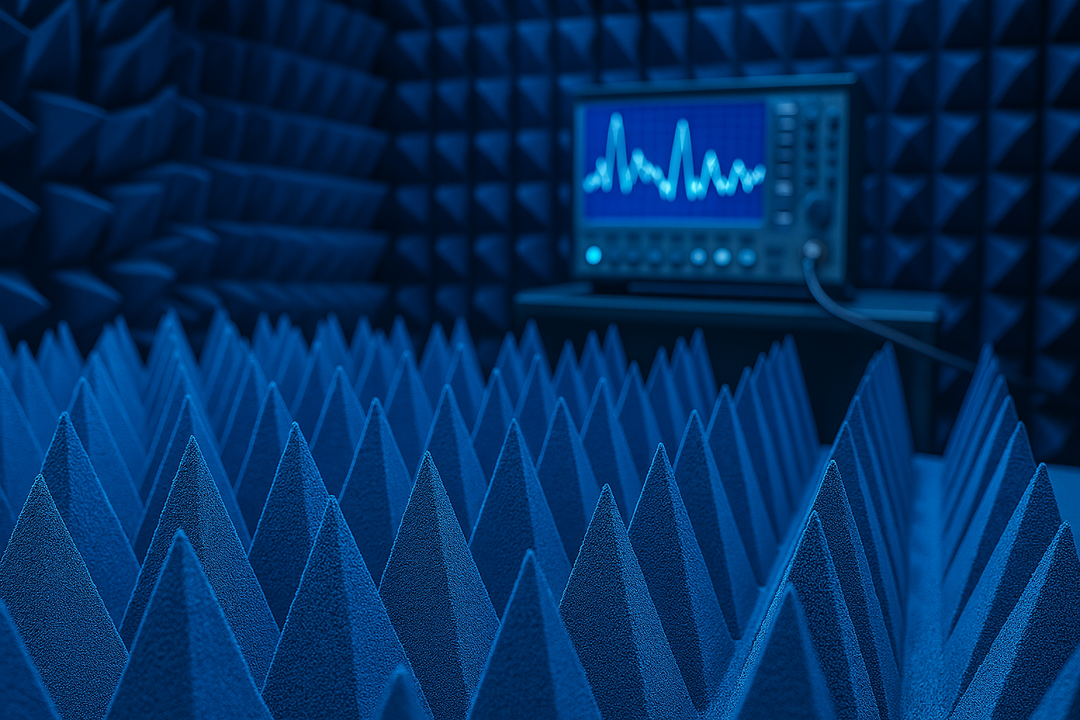
Standard polyurethane pyramidal foam remains the default choice for most EMC chambers, and for good reason – it's cost-effective and performs reliably across a wide frequency range for the majority of emissions and immunity testing.
Does Forced-Air Ventilation Actually Raise the Ceiling?
Yes – moving air pulls heat away from the absorber surface faster than passive convection, which allows the same material to handle noticeably more continuous power before reaching a damaging temperature.
Why This Matters for Budget-Conscious Labs
This is genuinely useful for facilities that can't justify switching to a more expensive absorber category. Instead of replacing material outright, adding forced-air ventilation near high-exposure zones can extend a chamber's practical power ceiling using an absorber that's already installed.
A few variables shape how much benefit ventilation actually delivers:
- Airflow rate and duct placement relative to the absorber surface
- Ambient chamber temperature before testing begins
- Whether the absorber in that zone is standard foam or the more porous filtered variant
Filtered foam is specifically designed for this scenario. Without forced air, it typically reaches around 1 W/in² – double the standard rating – and climbs further once ventilation is added.
When Foam Isn't Enough: Honeycomb and Phenolic Absorbers
Some test programs simply outgrow foam, no matter how well ventilated. High-power radiated immunity testing, certain automotive pulse programs, and labs running large amplifier arrays are the usual candidates.
Who Should Actually Consider the Upgrade?
Honeycomb phenolic absorber makes sense for facilities where:
- Field strengths regularly exceed what filtered foam can safely absorb
- Test programs run at elevated temperatures for extended periods
- Fire-retardancy documentation (UL 94, NRL-8093, or MIT Lincoln Laboratory MS-8-21) is a contractual requirement
Properly constructed, this category withstands up to 2 W/in² continuous wave and stays stable at temperatures as high as 250°C. The trade-off is cost, which is why most facilities install it selectively – near vents and high-exposure zones – rather than lining an entire chamber with it.
Fire Safety: The Half of the Conversation Often Skipped
Power handling and flammability are connected, since a chamber lined floor-to-ceiling in absorber represents a real fuel load if ignition ever occurs. UL Solutions' own combustion testing documentation outlines twelve distinct flame classifications under UL 94, including HF-1, HF-2, and HBF ratings specifically for low-density foam materials like absorber. Reputable pyramidal absorber lines are tested against these benchmarks, plus references like NRL Report 8093 and DIN 4102 Class B-2, before ever reaching a customer's chamber.
Choosing the Right Absorber
None of these numbers work in isolation. Frequency range, expected field strength, chamber ventilation, and test duration all shift the real-world ceiling up or down from whatever a datasheet lists. Treating every application the same way is usually how avoidable damage happens in the first place.
Sourcing pyramidal RF absorber directly from a manufacturer (rather than generic third-party stock) makes it easier to match material selection to actual test conditions instead of guessing from an average industry spec. Reach out for guidance on choosing standard, filtered, or honeycomb phenolic absorber suited to a chamber's real power levels, frequency range, and layout, and get a solution built around the tests actually being run.
Frequently Asked Questions
What's the difference between W/in² and kW/m² ratings?
They measure the same thing in different units. W/in² is common in North American spec sheets, while kW/m² shows up more often in European and international documentation. Standard foam rated at 0.5 W/in² roughly equals 1.5–1.8 kW/m².
Can forced-air ventilation replace the need for a higher-power absorber?
Not entirely. Ventilation extends the practical ceiling of existing material, but it doesn't turn standard foam into honeycomb phenolic. Once field strength consistently exceeds what filtered foam can handle, a material change becomes the safer option.
How long does a properly rated absorber typically last?
If installed correctly, kept within its rated power handling limits, and undamaged, foam absorber generally lasts for the working life of the chamber. Early replacement is usually about upgrading to better-performing material, not routine wear.
Does a higher power rating mean better RF performance overall?
Not automatically. Power handling and reflectivity are separate specifications. A honeycomb phenolic absorber handles more heat, but standard pyramidal foam can still outperform it in certain frequency ranges depending on shape and depth.