Anechoic Chamber Size Guide: 5 Key Factors for Sizing

5 Factors That Determine How Big Your Anechoic Chamber Needs to Be
How big does an anechoic chamber actually need to be? The answer depends on frequency, not guesswork. Under ANSI C63.4, a standard widely referenced by the FCC, electromagnetic compliance testing often requires a fixed 3-meter or 10-meter separation between the test antenna and the device under test – and that single number can shift a chamber's footprint by dozens of square meters.
Anechoic chamber size isn't a matter of picking a room and hoping it works. It's an engineering decision shaped by wavelength physics, test standards, and the equipment that has to fit inside. This guide walks through the five factors that matter most, plus a look at where absorber choice comes into play once the shell dimensions are locked in.
Why Anechoic Chamber Dimensions Vary So Much
Two chambers built for completely different purposes can look nothing alike. A room for testing a wireless earbud might fit in a small office. A room for automotive radar or full-vehicle EMC testing can resemble a small aircraft hangar.
The reason comes down to one variable above all others: frequency. Lower frequencies carry longer wavelengths, and test standards require enough physical clearance for at least one full wavelength to form between source and receiver before it reflects off a wall. That's the mechanism behind why anechoic chamber dimensions swing so widely across industries.
What Sets the Baseline for Sizing?
Before construction, engineers usually answer three questions: What's the lowest frequency to be tested? What standard governs the test (CISPR, ANSI, MIL-STD)? What's the largest object going inside? Once those are answered, most other dimensions fall into place logically rather than by trial and error.
1. Lowest Frequency of Interest
This is the anchor point. Lower target frequencies mean longer wavelengths, and longer wavelengths mean more required clearance.
A chamber rated down to 500 Hz can be meaningfully smaller than one built for 80 Hz testing. Facilities focused on low-frequency automotive or industrial acoustic work often need internal spans in the range of 7–8 meters per side, while chambers built for higher-frequency RF or electronics testing can be considerably more compact.
Pro tip: Chasing a lower frequency rating than a project actually needs is one of the most common (and costly) planning mistakes. Every additional meter of clearance adds real cost in construction, absorber material, and floor space.
2. Device Under Test (DUT) Size
What's being tested matters just as much as what frequency it's tested at. A chamber built for a smartphone antenna has entirely different space requirements than one built for a vehicle door module or an industrial motor assembly.
Larger test articles need more clearance on every side – not just around the object itself, but around any positioners, cabling, or support structures needed to hold it in place. This is where early planning sometimes goes wrong: a chamber is sized around frequency alone, and only later does anyone realize the actual equipment barely fits.
3. Quiet Zone Requirements
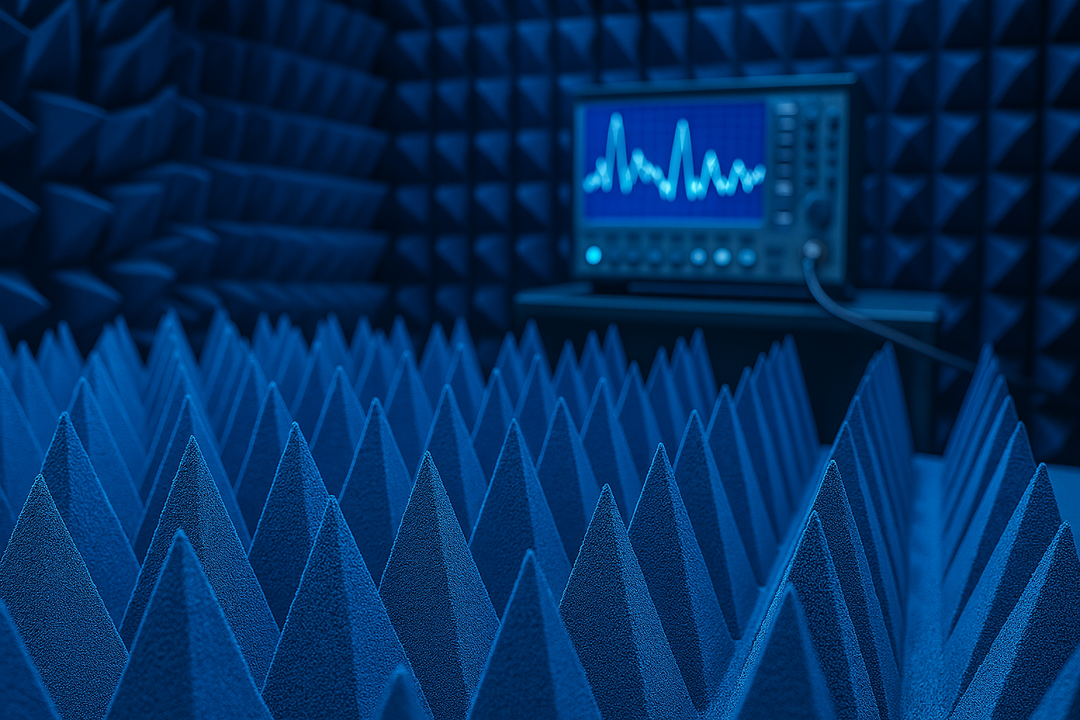
What is a quiet zone, exactly? It's the interior region where measurements are considered valid – the pocket of space with minimal reflected energy and stable field behavior, kept clear of the absorber-lined perimeter.
A larger quiet zone means more confidence in test results, but it also pushes the surrounding shell of the chamber outward to make room. Near-field scanning setups, for instance, need extra clearance so positioning equipment can move without brushing against absorber tips – that margin isn't wasted space, it directly protects data integrity.
4. Testing Standards and Regulatory Requirements
Standards bodies don't leave separation distances up to interpretation. Requirements are documented and fixed:
- CISPR 16 (maintained by the IEC) specifies standardized test distances of 3, 10, and 30 meters depending on the emissions class being measured
- ANSI C63.4, referenced directly by FCC compliance procedures, sets similarly fixed distances for radiated emissions testing
- MIL-STD-461 and related military specifications often impose their own separation and shielding requirements for defense applications
A facility built for compliance testing under any of these standards has to match the required distance exactly – no rounding down. This locks in a significant portion of the chamber's footprint before absorber depth or frequency range even enter the conversation.
Does Compliance Testing Change the Math?
Yes, and often more than people expect. A chamber designed purely around frequency performance can still fail certification if it doesn't meet the mandated source-to-antenna distance for the applicable standard. Confirming the target certification early avoids expensive redesign later.
5. Absorber Depth and Material
Absorber wedges do the actual work of soaking up reflected energy, and their depth directly determines how low a frequency the chamber can handle.
| Absorber Depth | Approximate Low-Frequency Cutoff |
|---|---|
| 200 mm | \~500 Hz |
| 500 mm | \~200 Hz |
| 1000 mm | \~80–100 Hz |
The tradeoff here is straightforward: deeper absorbers eat into usable interior space. A chamber with a fixed outer shell will have a noticeably smaller working volume once thick wedges line every wall, floor, and ceiling.
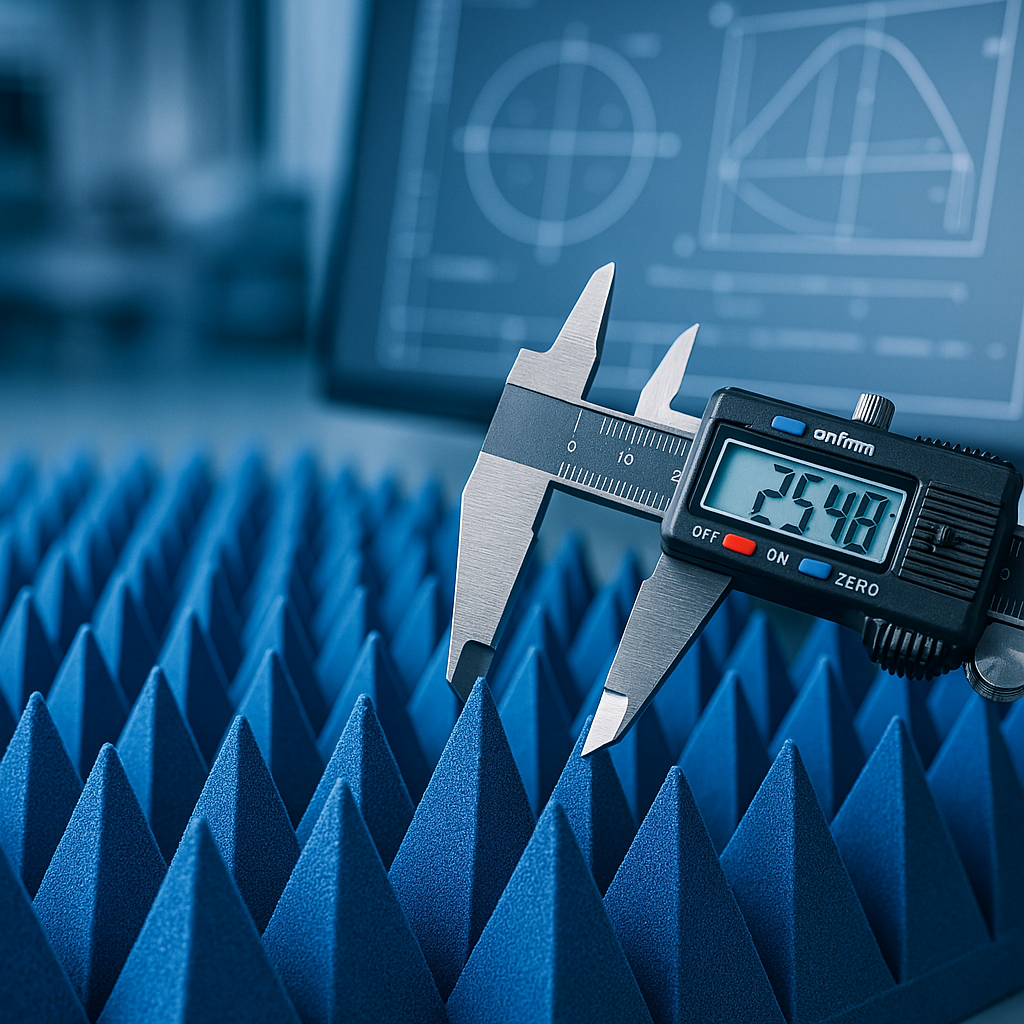
This is exactly why pyramidal RF foam absorbers have become a popular middle ground. They deliver strong reflectivity performance across the frequency bands most RF and EMC testing actually requires, without demanding the extreme depths that dense fiberglass or ferrite tile sometimes call for.
Common absorber materials break down as follows:
- Melamine foam – lightweight, fire-retardant, easier to install
- Fiberglass – stronger low-frequency absorption, but heavier and more complex to mount
- Pyramidal foam – balanced performance, manageable weight, straightforward installation across most commercial and industrial test ranges
Bringing the Five Factors Together
None of these variables work in isolation. Frequency sets the baseline. DUT size pushes the working volume outward. Quiet zone requirements carve out protected space inside that volume. Testing standards may override everything with fixed distance mandates. And absorber depth quietly determines how much of the outer shell gets consumed before any usable space is left.
A chamber that optimizes for one factor while ignoring another tends to land in one of two places: overbuilt and needlessly expensive, or undersized and unable to deliver valid results at the frequencies that matter. The objective isn't maximizing anechoic chamber size – it's matching dimensions precisely to the testing mission at hand.
Why Absorber Selection Deserves the Most Attention
Of the five factors above, absorber choice is the one most within direct control once shell dimensions are fixed. The right pyramidal foam absorber can be the difference between a chamber that hits its frequency target with room to spare and one that falls just short of certification requirements.
Get the Right Absorbers
Sizing a chamber correctly means very little without absorber material that actually performs at the target frequency. Reach out to db Absorber for guidance on selecting pyramidal RF foam absorbers matched to specific frequency requirements, quiet zone dimensions, and applicable testing standards – before a single wall goes up.
Frequently Asked Questions
How is anechoic chamber size calculated?
It starts with the lowest test frequency, then factors in DUT size, required quiet zone volume, applicable testing standard distances, and absorber depth needed to hit that frequency target.
What's the minimum size for an EMC compliance chamber?
It depends on the standard being tested against – CISPR 16 and ANSI C63.4 both specify fixed distances (commonly 3 or 10 meters) that directly set the minimum internal dimensions.
Do thicker absorbers always mean a bigger chamber?
Not necessarily bigger overall, but they do reduce usable interior space within a fixed outer shell – which is why absorber selection matters as much as room dimensions.
Are pyramidal foam absorbers suitable for low-frequency testing?
They perform well across common RF and EMC frequency ranges and offer a practical balance of weight, cost, and absorption compared to denser materials.