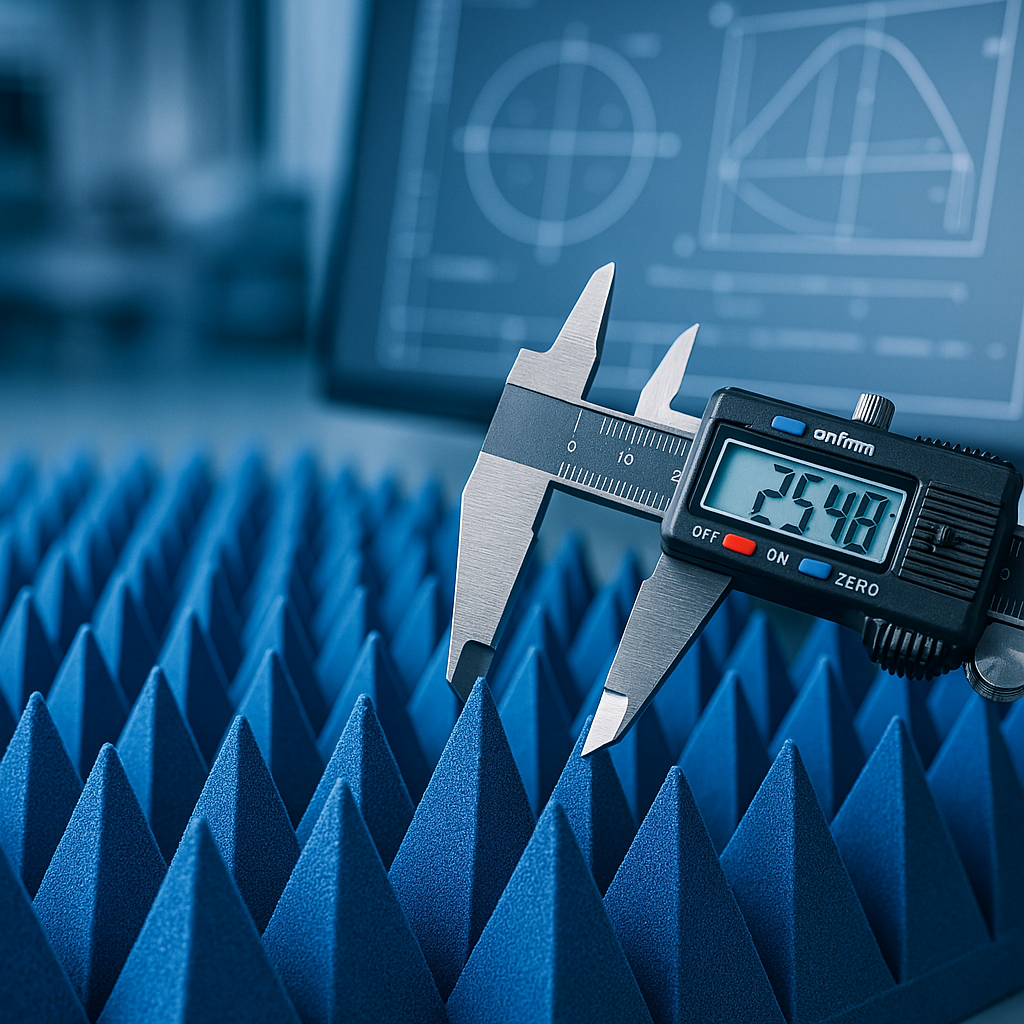
When to Use the RF Absorber 8in Pyramidal: Comparing It to 2in, 4in, and 12in Absorbers
Testing electromagnetic compatibility isn't just about having the right equipment—it's about choosing components that match your specific frequency requirements. RF absorbers come in various sizes, and selecting the wrong one can compromise your test results or waste valuable resources. The RF absorber 8in pyramidal sits in an interesting middle ground, offering capabilities that might surprise you when compared to its smaller and larger counterparts.
Engineers and technicians working in telecommunications, aerospace, automotive, and research facilities face this decision regularly. Should you go with a compact 2-inch solution, opt for the versatile 8-inch model, or invest in the larger 12-inch absorbers? Each size serves distinct purposes, and understanding these differences helps ensure your testing environment delivers accurate, repeatable results.
The electromagnetic spectrum demands different approaches at different frequencies, and physical dimensions play a crucial role in absorption effectiveness. Getting this choice wrong means either overspending on unnecessarily large absorbers or dealing with inaccurate test results from undersized ones.
Understanding RF Absorbers and Their Functions
Before comparing specific sizes, it's worth understanding how these materials work and why their dimensions matter.
What is an RF Absorber?
An RF absorber is a specialized material designed to suppress unwanted electromagnetic reflections in testing environments. These materials convert electromagnetic energy into heat, preventing signal bounce-back that could interfere with measurements. You can think of them as acoustic foam for radio waves—they create "quiet" spaces where only the intended signals exist.
The technology relies on carefully engineered materials that interact with electromagnetic fields at specific frequencies. Carbon-loaded foam and urethane compounds are common choices, each formulated to handle different frequency ranges.
Types of RF Absorbers and Their Material Composition
Several absorber types exist in the market, but pyramidal designs dominate professional testing facilities. Flat absorbers work well for high-frequency applications, while convoluted absorbers handle mid-range frequencies effectively. The pyramidal RF absorber stands out due to its graduated impedance matching—the pointed shape creates a smooth transition from free space to the absorbing material.
Most pyramidal absorbers use polyurethane foam impregnated with carbon or other conductive materials. The concentration of these additives determines how well the absorber works at different frequencies. Higher carbon content generally improves low-frequency absorption but adds weight and cost.
How Absorber Size Affects Performance
Size matters significantly in RF absorption. Larger absorbers can handle lower frequencies because the physical dimensions need to match the wavelength of the electromagnetic energy being absorbed. A 2-inch absorber might work great at frequencies above 2 GHz, while a 12-inch model becomes necessary for frequencies below 500 MHz.
The pyramidal rf absorber in 8-inch configuration bridges this gap nicely, providing solid performance from roughly 800 MHz upward. This versatility makes it suitable for many common testing scenarios without requiring the space and expense of larger alternatives.
The Science of Pyramidal RF Absorbers
The unique geometry of pyramidal absorbers gives them clear advantages over other designs.
Why the Pyramidal Shape is Effective
The pyramidal design works better than flat absorbers by creating multiple reflection points as electromagnetic waves travel toward the base. Each reflection reduces the wave's energy bit by bit, and the tapered geometry prevents sudden impedance changes that would cause reflections back into the test chamber.
This graduated approach allows the pyramidal RF absorber to maintain consistent performance across broader frequency ranges than alternative designs. The multiple facets of the pyramid scatter and absorb energy at the same time, making the shape particularly valuable in anechoic chambers where uniform absorption is critical.
How Pyramidal RF Absorbers Perform Across Different Frequency Ranges
The relationship between absorber height and effective frequency is pretty straightforward: taller pyramids work better at lower frequencies. A 2-inch pyramidal absorber typically performs well from 3 GHz upward, making it suitable for Wi-Fi, Bluetooth, and many wireless communication tests. The RF absorber 8in pyramidal extends this range downward to approximately 800 MHz, covering cellular frequencies, ISM bands, and many automotive radar applications.
Moving to 4-inch absorbers pushes the lower frequency limit to around 1.5 GHz, while 12-inch models can effectively absorb frequencies as low as 400 MHz. This scaling isn't perfectly linear—material properties and manufacturing quality play significant roles—but it gives you a useful guideline for initial selection.
Comparing the RF Absorber 8in Pyramidal to Other Sizes
Each absorber size serves specific purposes, and knowing these differences helps you make smarter decisions for your testing setup.
The RF Absorber 8in Pyramidal: Advantages and Applications
The 8-inch pyramidal absorber hits a sweet spot for many facilities. Here's why it's often the first choice:
- Frequency coverage: It handles most modern wireless protocols, including LTE, 5G sub-6GHz, Wi-Fi 6, and automotive radar bands effectively
- Space efficiency: Compared to 12-inch absorbers, the 8-inch version requires less chamber depth while still providing solid performance
- Cost balance: It delivers professional-grade results without the premium pricing of larger absorbers
The RF absorber 8in pyramidal fits well in mid-sized anechoic chambers and semi-anechoic rooms. Manufacturing facilities testing consumer electronics find this size particularly practical because it covers the frequency ranges most commonly required for compliance testing without demanding excessive ceiling heights or floor space.
When to Use the 2in Pyramidal RF Absorber
The 2-inch pyramidal absorber serves specific niches where high frequencies dominate. Millimeter-wave testing above 20 GHz benefits from these compact absorbers, as do applications where chamber space is severely limited. They're also more budget-friendly when your testing exclusively targets frequencies above 3 GHz.
However, using 2-inch absorbers for cellular frequencies or lower bands will yield poor results. The physics simply doesn't support effective absorption when the pyramid height is much smaller than the wavelength being tested.
The 4in Pyramidal RF Absorber: A Balanced Solution
Four-inch absorbers split the difference between compact design and extended frequency coverage. They're suitable for facilities that primarily test above 1.5 GHz but occasionally need to verify performance at slightly lower frequencies. Many laboratories use 4-inch absorbers in areas where budget constraints prevent full 8-inch coverage, but 2-inch absorbers would fall short.
The 12in Pyramidal RF Absorber: High-Performance for Low Frequencies
When testing requirements extend below 800 MHz—such as UHF radio systems, low-band cellular, or certain military applications—the 12-inch pyramidal absorber becomes necessary. These large absorbers provide the physical depth needed to attenuate wavelengths that can exceed 30 centimeters effectively.
The tradeoff is significant, though: 12-inch absorbers are heavy, expensive, and require chambers with substantial interior dimensions. A room lined with 12-inch absorbers needs at least 10 feet of height and corresponding width and length to function properly as an anechoic space.
Practical Applications of the 8in Pyramidal RF Absorber
Real-world applications show why the 8-inch pyramidal absorber has become an industry standard.
Common Uses in EMC Testing
Electromagnetic compatibility testing relies on controlled environments where external signals don't mess with your measurements. The RF absorber 8in a pyramidal creates these conditions for the frequency ranges most relevant to modern electronics. Radiated emissions testing for FCC and CE compliance typically falls within the 8-inch absorber's effective range.
These setups allow engineers to identify whether products emit electromagnetic interference that could disrupt other devices. The absorbers prevent reflections that would create measurement errors, so test results accurately represent the device's actual emissions. According to research from the IEEE on anechoic chamber design and performance, proper absorber selection directly impacts measurement accuracy and repeatability in EMC testing environments.
RF Testing in Consumer Electronics and Automotive Industries
Smartphones, tablets, laptops, and wireless accessories all go through RF performance testing during development. The RF absorber 8in pyramidal supports testing of:
- Antenna efficiency measurements across cellular and Wi-Fi bands
- Wireless connectivity performance verification under controlled conditions
- SAR (specific absorption rate) testing for devices used near the human body
Automotive applications have grown dramatically with the introduction of collision avoidance radar, adaptive cruise control, and vehicle-to-vehicle communication systems. These operate in frequency bands where 8-inch absorbers provide excellent performance, making them standard in automotive test laboratories worldwide.
Role in Research and Development Environments
Universities and private research facilities use the RF absorber 8in a pyramidal form for antenna development, wireless protocol research, and electromagnetic theory validation. The controlled environment allows researchers to isolate variables and collect data without environmental interference.
Research applications often need flexibility since projects may span various frequencies and technologies. The 8-inch pyramidal absorber provides broad enough coverage to support multiple research streams without requiring facility reconfiguration between projects.
Making the Right Choice for Your Application
Start by identifying your lowest test frequency—this determines your minimum absorber size. The RF absorber 8in pyramidal handles frequencies from 800 MHz to 18 GHz, covering most contemporary wireless technologies without the expense of larger alternatives. For best results, consult with RF testing professionals to confirm your selection matches your specific needs.
Looking for high-quality RF absorbers? Browse our in-stock pyramidal absorbers — shipping from California in 1-2 business days.